

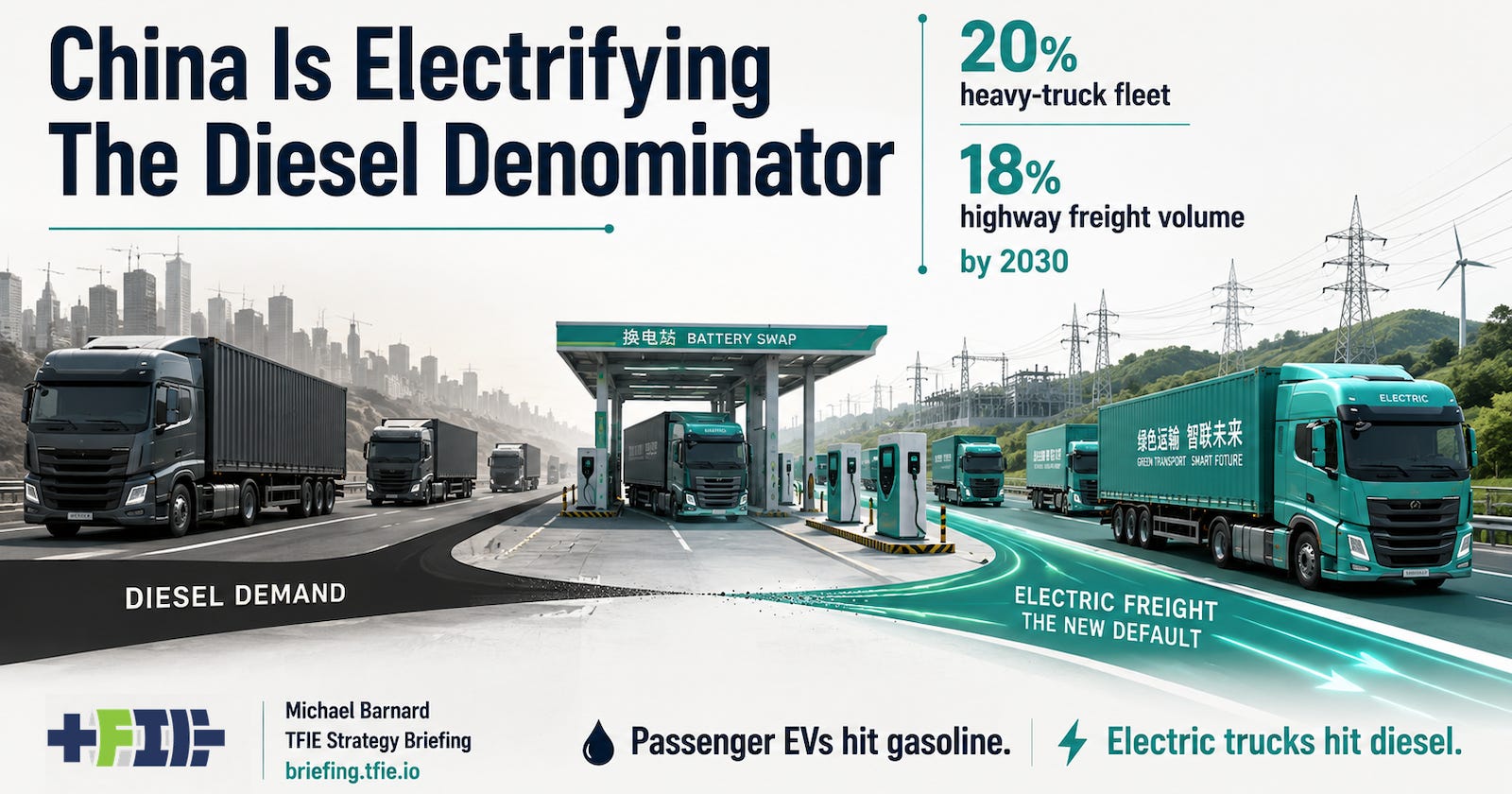
China’s heavy-truck electrification plan changes the oil demand argument because it reaches the part of transport fuel that vehicle counts tend to hide. Passenger EVs are the visible story. They are large, obvious and already undermining gasoline growth. Heavy trucks are less visible, but they burn diesel at high utilization, and China is now moving them from scattered electric models into a coordinated freight system.
That matters for any oil demand forecast that still treats China as the dependable growth engine for crude. The IEA’s Oil 2025 says Chinese oil demand rose by nearly 6 million barrels per day from 2015 to 2024, equal to about 60% of global oil-demand growth over that period. It now expects a very different 2030 picture, with China’s oil demand peaking this decade as EVs, LNG trucks, high-speed rail and structural economic shifts weaken road-fuel demand. The IEA is already closer to the right direction than forecasts that still treat China as a combustion-growth engine, but even that may understate the freight shift now underway.
China’s new heavy-truck plan targets 40% new-energy heavy-truck sales by 2030, more than 1.6 million vehicles in the fleet, about 20% of the total heavy-truck fleet and 18% of highway freight volume. Those are not passenger-car adoption numbers translated into a larger vehicle class. They are freight numbers. The relevant denominator is not how many trucks exist. It is how much diesel is burned by the trucks that move large shares of highway freight every day.
That was the point of my earlier Briefing piece on China’s truck plan. China did not merely create a target for electric trucks. It attached electric trucks to corridors, depots, charging, battery swapping, logistics parks, service areas, grid planning, standards, repair networks, insurance and priority freight use cases. The plan calls for roughly 30,000 km of zero-carbon highway freight corridors and about 3,000 heavy-truck charging and swapping stations, with grid companies told to include heavy-truck charging and swapping demand in distribution-grid planning. That is the difference between counting electric vehicles and watching a diesel system start to lose load.
A few electric trucks in pilots are an adoption signal. Electric trucks tied to freight corridors, depots, mines, ports, logistics parks and grid upgrades are a diesel displacement signal. Oil models that treat truck electrification as a sales-share curve risk missing the system being built around the trucks, and that system matters because freight is not a casual consumer market. Fleet operators care about uptime, route certainty, delivered energy cost, maintenance, financing and whether the equipment can be dispatched tomorrow without special handling. China’s plan is aimed at those dull operational details, which is why it deserves more attention than another round number on a target slide.
The bottom-up diesel effect is already large enough to matter. A 20% electric share of China’s heavy-truck fleet aimed at 18% of highway freight volume plausibly removes several hundred thousand barrels per day of diesel demand by 2030. The range depends on which trucks are replaced. China’s scrappage focus makes the high end more credible because older diesel trucks are being pushed out, although not every old vehicle is a high-mileage vehicle. That caveat matters for passenger cars. It matters less for commercially active heavy trucks, where an old vehicle that is still in service is more likely to be burning meaningful fuel.
Electric trucks are not the only diesel wedge. LNG trucks are not a climate solution, but they are oil displacement from Beijing’s perspective. Chinese state-linked researchers cited by Reuters expect LNG heavy trucks to replace 38 million tons of diesel, or about 775,000 barrels per day, by 2030. The same reporting said EVs were already replacing at least 25 million tons of gasoline, or 582,000 barrels per day, in 2025. Add passenger EVs, electric trucks, LNG trucks, high-speed rail, weaker construction diesel and urban logistics electrification, and the transport-fuel story that supported China’s oil growth looks increasingly thin.
This is where OPEC’s latest reported oil outlook becomes exposed. OPEC still sees global oil demand rising from about 105 million barrels per day in 2025 to more than 113 million barrels per day in 2030, with no peak through 2050. That outlook does not require China alone to do all of the work, but it does require China’s road-fuel losses to be offset by petrochemicals, aviation, slower electrification elsewhere and rising demand in other emerging markets. That is a possible pathway, but it is no longer the clean China-led growth story oil markets became accustomed to using.
The import story is more complicated, and that is where the analysis can overreach. China’s crude imports are not the same thing as China’s transport fuel demand. China imported about 11.55 million barrels per day of crude in 2025, but Rystad estimated that stockbuilding accounted for about 430,000 barrels per day of that. Customs import data can stay high when Beijing is filling storage, when refiners are taking advantage of prices or sanctions discounts, or when petrochemical demand absorbs more crude and products. Falling gasoline and diesel demand does not immediately produce a clean one-for-one fall in crude imports.
But that caveat does not rescue the old growth story. It separates durable demand from inventory behavior. If imports are being supported by storage, they are less useful as a signal of structural demand. If petrochemicals are becoming the main remaining growth pool, then oil has already lost the transport engine that made China such a reliable demand story. Petrochemicals can absorb barrels. They do not recreate the old pattern of more cars, more trucks, more road freight and more diesel.
The professional distinction is now between oil demand plateau and crude import contraction. Agencies mostly forecast demand. Exporters and refiners live with flows, margins, product demand and storage behavior. China can keep importing heavily for a while even as road fuels weaken, especially when prices are attractive and energy-security logic favours stockbuilding. That does not restore the growth path. It only changes how long the transport-fuel decline is masked in headline import data.
China’s truck plan therefore makes oil forecasts wrong in different ways. The IEA has already shifted from China as growth engine to China as peak-this-decade, which is the right directional move. OPEC-style outlooks remain more dependent on combustion demand being replaced elsewhere before China’s losses become visible in the global total. The more China turns freight electrification into corridors, charging, swapping, depots and grid planning, the harder it is to treat diesel demand as a slow-moving legacy variable.
The point is not that every Chinese truck becomes electric by 2030. China’s own target says most will not. The point is that a 20% electric fleet share, aimed at 18% of highway freight volume and concentrated in high-use corridors, is enough to matter at national diesel scale. It is enough to matter to crude import expectations. And it is enough to make oil demand forecasts built around the previous Chinese freight system increasingly unreliable.
Free TFIE Strategy Briefing posts carry the public argument. Paid posts add the professional layer: evidence notes, denominator checks, comparator discipline, update triggers and decision-grade context for people working around the transition.