

The obvious climate read of Mark Carney’s Alberta pipeline deal is that Ottawa has capitulated to Danielle Smith, the oil sands and the familiar Canadian habit of treating bitumen exports as a national unity program with pipe attached. Alberta certainly gets to tell that story. The federal government is talking again about a west-coast pipeline, the Major Projects Office is in the frame, the language of national interest is back in circulation, and Canada is once again telling itself and the world that it is open for business.
That reading is understandable. The concessions are real, the optics are ugly, and the oil and gas industry will happily treat the deal as a win. But it is not the best reading. The more useful question is not whether the optics favour Alberta. They do. The better question is whether Carney has actually made a new pipeline likely. On the evidence so far, he has not.
What he has given Alberta is a process with enough public symbolism to matter politically. What he has not given Alberta is the thing that made the last west-coast oil pipeline happen: a public balance sheet willing to absorb risks private capital would not carry. The proposed pipeline is still trapped behind private finance, upstream oil sands capital, B.C. politics, Indigenous consultation, tanker-law risk, methane requirements, carbon pricing, the Pathways carbon capture dependency and the long fiscal shadow of Trans Mountain.
That makes this a strange deal. It is useful to Alberta because it looks like pipeline momentum. It is useful to Carney because it blunts the “Ottawa blocks everything” attack and lets Canada sound like a serious resource state in a world that still has energy-security anxiety. But it is not yet useful to anyone who wants to finance, permit and build a new 1 million barrel per day pipeline to tidewater. That remains a very different problem.
The deal’s political value is real. Alberta can say it forced the federal government to recognize west-coast oil export capacity again. Carney can say his government is willing to advance major projects, diversify exports and work with producing provinces instead of lecturing them. That matters in a country where federal-provincial energy politics can turn a moderately complex infrastructure file into a much larger fight over jurisdiction, identity and money.
But process is not only a gift. In this case, it is also a test. Alberta still has to turn a political proposal into a bankable project, and the conditions embedded around that proposal are not trivial. A real pipeline needs a named proponent, route clarity, capital cost, toll assumptions, binding shipper commitments, equity, debt, Indigenous participation, regulatory durability and upstream production that justifies the capacity. It also needs a way through B.C., affected First Nations, tanker politics, the Pathways linkage, methane policy and the industrial carbon-pricing bargain.
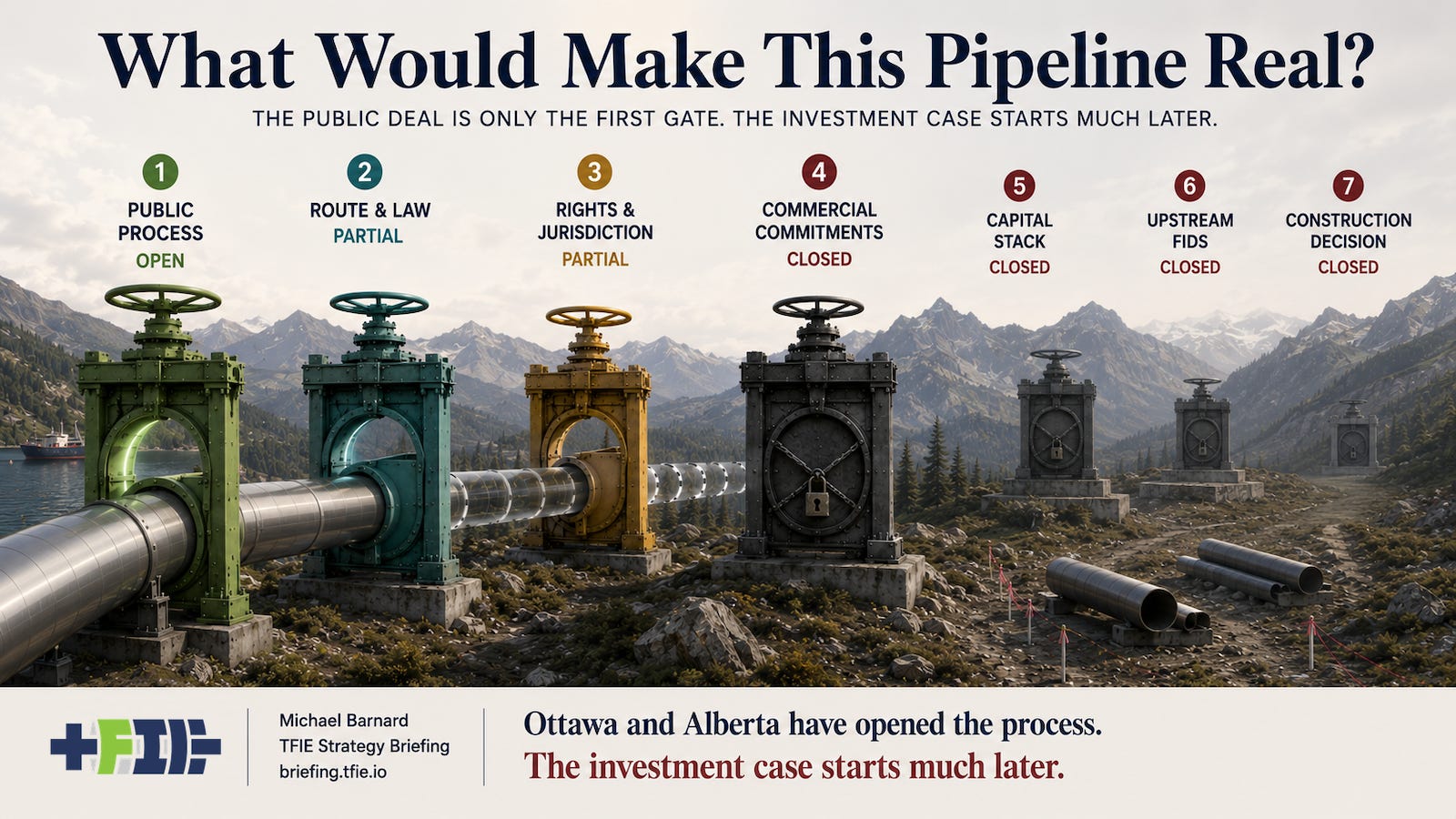
That is why the denominator matters. The public argument will be pulled toward whether Ottawa is now pro-pipeline or anti-pipeline. That is useful for slogans and useless for project finance. The professional question is whether the commercial stack exists. Supportive language is not capital. Conditional interest is not commitment. A government-led early proposal is not the same thing as a private-sector project.
If this is capitulation, it is a peculiar kind. Alberta gets the microphone, but not the money, not the shippers, not the route, and not relief from the burden of proving the thing can be built without turning into another federally carried megaproject.
Trans Mountain is the reference case because Canada has already run this experiment. Private capital stepped back. Ottawa stepped in. The project delivered physical capacity, but only after the federal government bought the asset, carried construction and political risk, absorbed massive cost escalation and inherited the toll and sale-value problem. I’ve made that case before in my analysis of TMX’s roughly $3 billion a year oil and gas subsidy lesson, and it is the fiscal shadow hanging over every new Canadian pipeline conversation.
That history matters because the new proposal will eventually ask the same question if private capital stays away: who eats the downside? In the case of TMX, the answer was the Canadian public. The cost escalation, toll dispute and under-recovery problem are not side notes. They are the warning label on any new national-interest pipeline that lacks private capital.
Carney has not crossed that line. He has not said Ottawa will buy, build, guarantee or publicly finance another west-coast pipeline at TMX scale. He has offered tone, process and possible regulatory navigation. That may be politically significant, but it is not the same as writing a federal cheque or creating a financing structure that makes the project bankable. The line to watch is not whether Ottawa accepts an application. The line to watch is whether Ottawa starts moving risk from private balance sheets onto the public one.
The missing money is not only pipeline money. It is pipeline money plus upstream capital with a west-coast destination. That second half of the problem is easy to miss because the oil sands have not stopped investing, and Alberta’s production does not vanish because climate advocates would prefer a cleaner chart. The issue is the character of the capital. Current oil sands investment looks much more like mature-asset optimization than a new frontier expansion cycle.
That can support incremental growth and better margins. It can make existing assets more productive. It can help producers generate cash. What it does not obviously do is support a new 1 million barrel per day west-coast export corridor. That would require either rerouting a large volume of existing barrels away from current pathways or creating a much larger upstream growth wave than is visible in current corporate behaviour.
The distinction matters. Alberta can plausibly point to continued bitumen production growth, including the Alberta Energy Regulator’s forecast that raw bitumen output continues rising through 2034. That does not settle the question. The relevant question is not whether Alberta production can grow. It is whether enough committed production exists, or will be financed, to justify a new west-coast line after existing routes and TMX are accounted for.
On that denominator, the story still looks weak. Oil sands producers are behaving like mature cash-flow operators, not companies preparing for another megaproject boom. That is rational. Long-lived, high-capex, high-carbon assets in a world of uncertain demand and policy risk should be managed carefully. Capital discipline can preserve returns. It does not, by itself, fill a new pipe.
That is why the pipeline likelihood and the climate-politics interpretation need to be separated. None of this means the climate concessions are imaginary. They are not. The point is narrower: concessions that improve Alberta’s political and regulatory position are not the same thing as a publicly financed pipeline or a bankable private project.
None of this makes the deal meaningless either. It may be strategically useful, depending on what Carney does next. Alberta gets a process and a political win without Ottawa buying the project. The federal centre gets to say Canada is open for major projects and resource development. The right loses some oxygen for the familiar claim that Ottawa simply blocks everything that carries hydrocarbons. The climate community gets something more ambiguous: an ugly-looking fossil signal, but one still constrained by private finance, carbon pricing, methane, Pathways, B.C. politics and the absence of a federal build cheque.
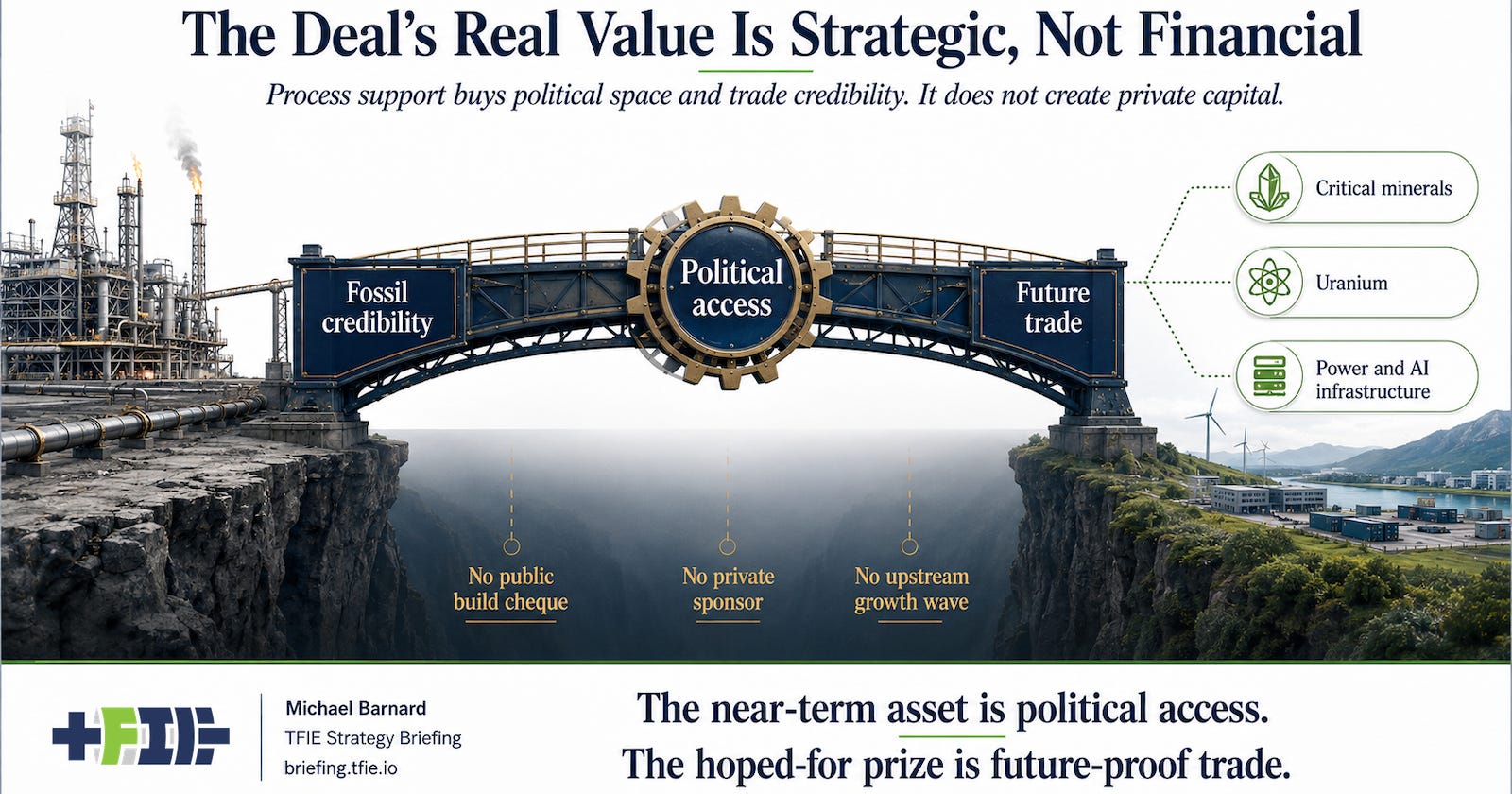
There is also an international trade angle that deserves more attention. Fossil-energy credibility still opens doors with energy-hungry governments and major industrial firms. Canada can enter those rooms as a serious G7 resource state, not as a country offering only climate-policy language. Once in the room, the more durable trade may be in critical minerals, uranium, electricity, grids, batteries, AI power infrastructure, defence supply chains and resilient trade corridors.
That does not mean the fossil side is imaginary. Canada is still making fossil-adjacent choices, and some of them carry real lock-in and subsidy risks. But the strategic reading is that Carney is using the whole Canadian resource stack to rebuild trade leverage during an energy-security moment. Oil and gas keep some doors open today. Critical minerals, electricity, uranium and industrial supply chains may be the more future-proof prize.
The caveat is the whole game. Fossil credibility as an entry ticket to future-facing trade is defensible. Fossil infrastructure risk socialized through the public balance sheet is not. If the bridge to future-proof trade becomes another lane for subsidized oil infrastructure, then this starts to look much less clever and much more like a tailored sequel to TMX.
Carney has given Alberta a process that looks politically useful and remains commercially difficult. The hard gates are still closed: private capital, binding shippers, upstream FIDs, B.C., Indigenous consultation, tanker politics, Pathways and the TMX precedent.
The July 1 milestone should therefore be read as a political submission deadline, not a financeability deadline. If Alberta produces an application and no private capital appears, that does not prove the pipeline is advancing. It proves Alberta has preserved the argument.
Below the paywall is the professional layer: two companion evidence workbooks covering the TMX cost/toll/subsidy reference case and the oil sands capex/private-capital signal test, plus the major-firm signal matrix, private-capital gate tracker, policy concession ledger, update triggers, decision implications and the final scorecard I’ll use to judge whether this is becoming a financeable project or remains a political pathway with no commercial coalition behind it.
