

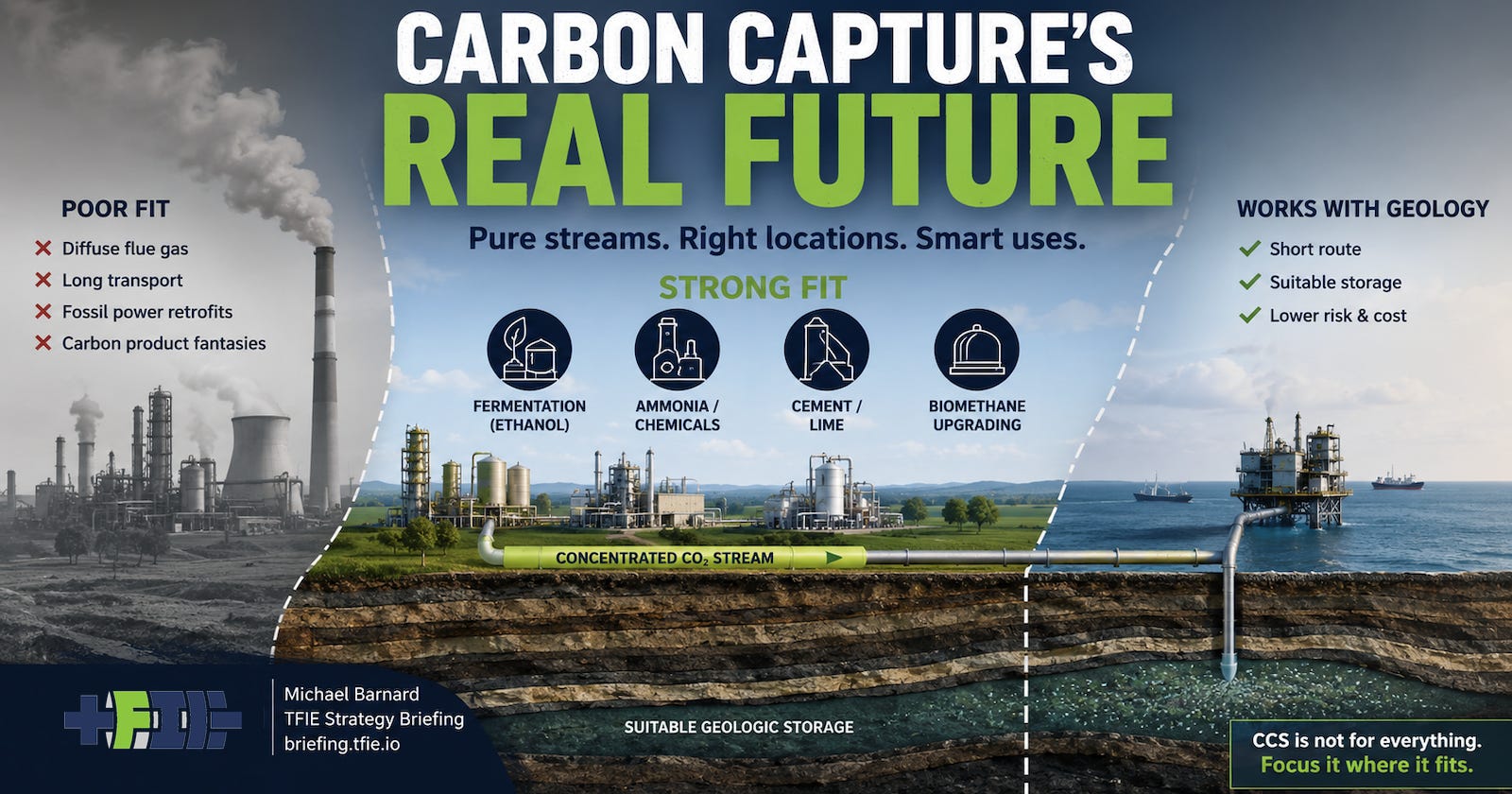
Carbon capture and storage has been marketed as a general solution to climate change. The record shows it is not. Where it does make sense is where chemistry gives you a high-volume, concentrated stream of CO₂, where geography puts that stream on top of storage or at a pier with pipeline routes offshore, and where policy puts a real value on abatement. Everywhere else, CCS is outcompeted by electrification, efficiency, process substitution or stopping the emitting activity.
The point is not to dismiss CCS. The point is to use it only where it is the lowest-cost path to real emissions cuts.
Purity is the first filter. Capture from dilute flue gas is an energy and money sink because you are separating a small fraction out of a big inert stream. Fermentation off-gas from ethanol production is almost pure CO₂ with water vapor and trace organics. Dry it, compress it and inject it. Steam methane reforming in ammonia plants makes hydrogen and a high-CO₂ stream that is already separated in the process train. Lime and cement kilns release CO₂ from calcination of limestone.
If the heat source and gas path are engineered correctly, process CO₂ can be kept relatively clean of combustion products. Biogas upgrading splits methane and CO₂. The CO₂ side is close to pure. In metallurgy, direct reduction of iron using biomethane produces concentrated CO₂ streams that can be compressed and stored without the costs of scrubbing flue gases. These are the places where capture is not a giant chemical plant bolted on top of another plant. They are housekeeping steps on streams that already exist.
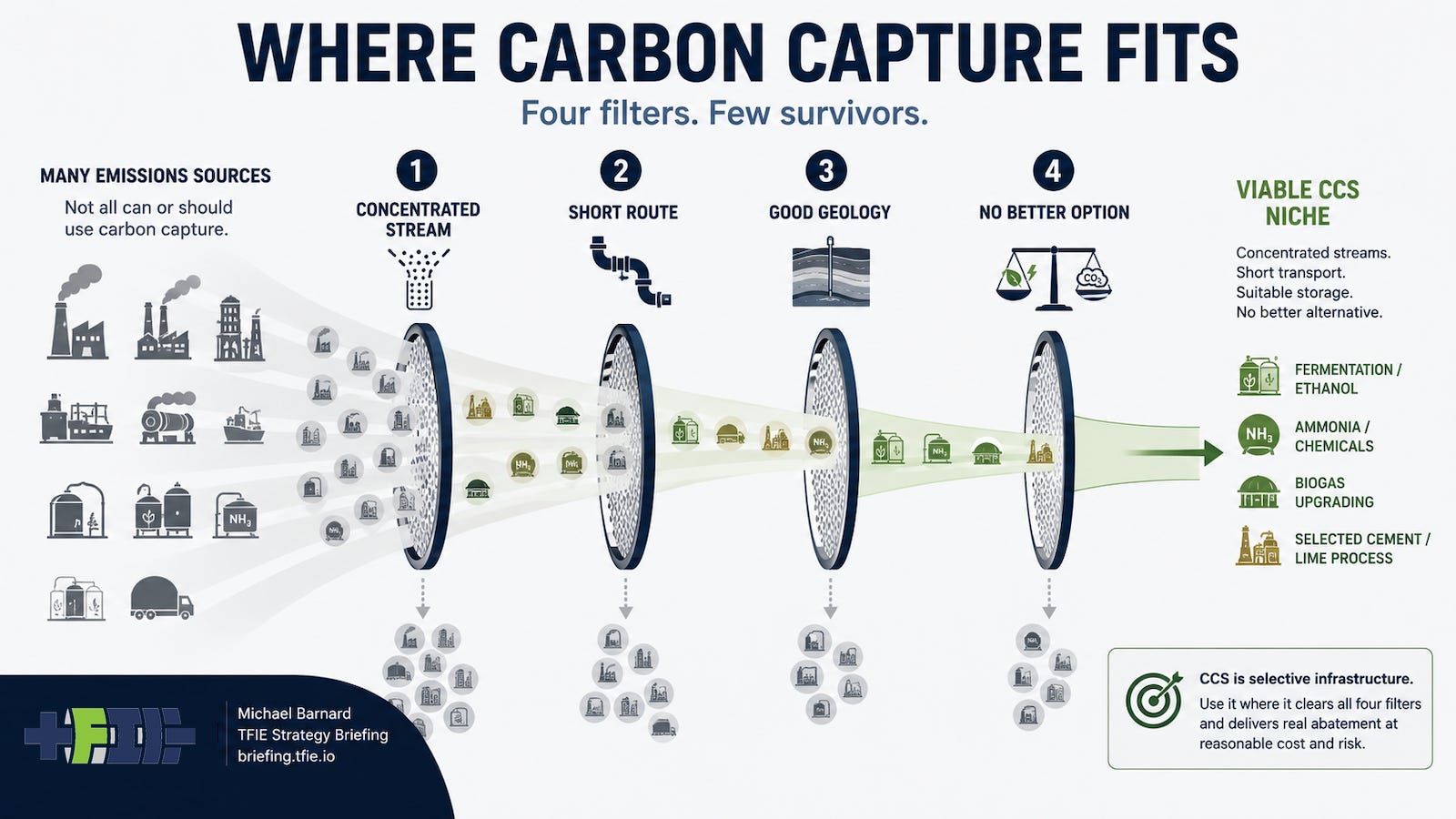
Location is the second filter. Every kilometer of pipe, and especially every non-pipeline pathway, adds cost and public risk. On-site injection into proven saline formations solves both if the geology cooperates, as in Illinois and North Dakota. Waterside plants with short pipelines to offshore storage, as around the North Sea, can also be sensible. Trying to build continent-spanning liquid CO₂ networks across cities for low-purity sources is not.
The economics collapse under capital, compression power, right-of-way fights and safety engineering. Good CCS projects look boring on a map. They sit next to their sinks.
Policy is the third filter. A project lives or dies on the value per ton. If capture and storage from a pure stream can be done near or below the combined value of the carbon price, credits for removals and any targeted support, and is cheaper than alternatives, it pencils out. If not, it struggles in a market full of other ways to cut emissions. That is why the early movers are mostly in the easiest categories with public support, not in general fossil combustion.
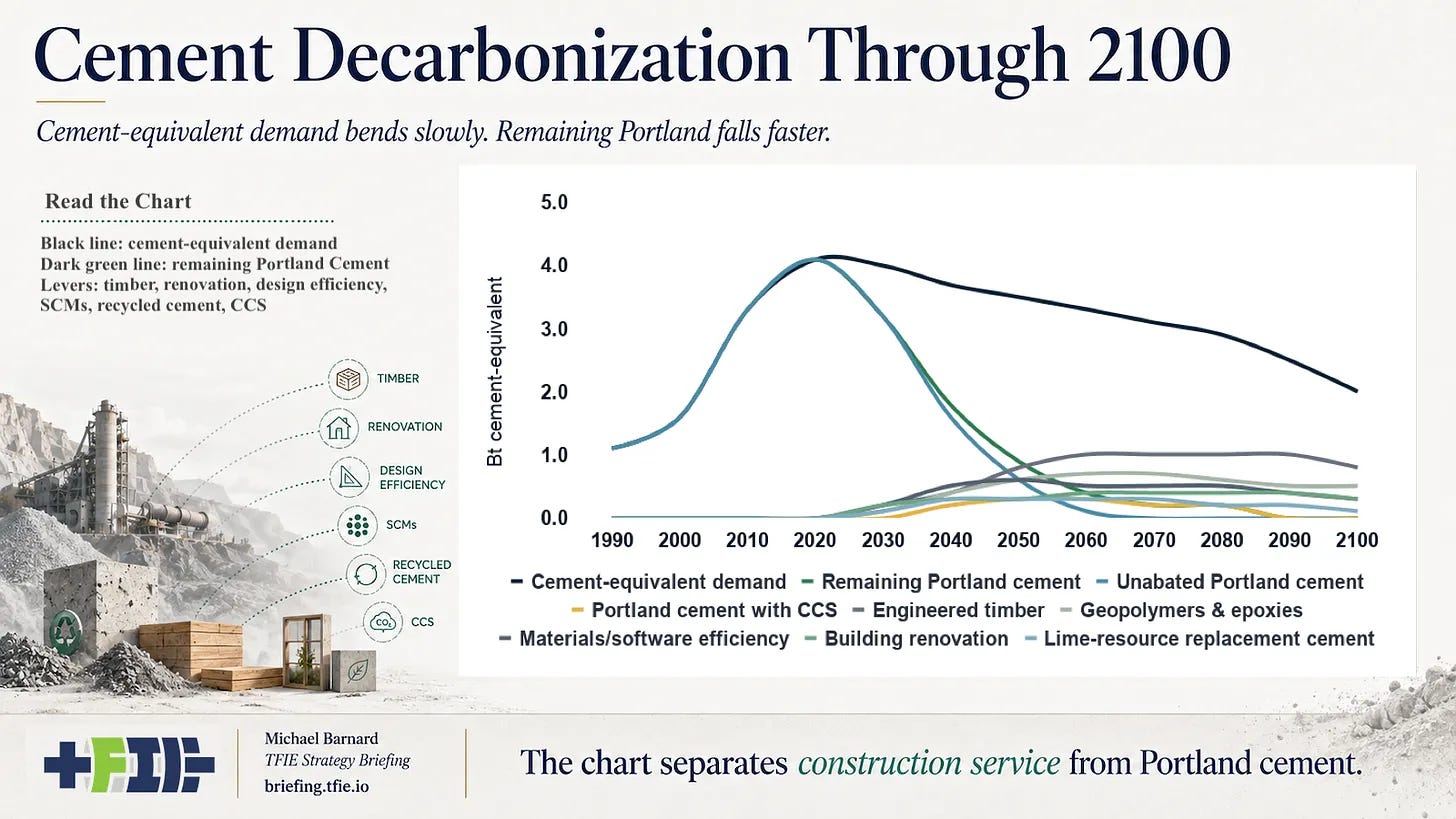
That is why my projection of cement demand through 2100 shows relatively low amounts of cement with CCS. We have a large number of alternatives to cement, and most of them are cheaper than cement with CCS in most locales, leaving limited opportunity for CCS outside the remaining hard-to-substitute process-emissions wedge.
Ethanol fermentation is the cleanest CCS niche. The chemistry is simple. Yeast converts sugars to ethanol and CO₂. The off-gas is nearly all CO₂. Plants that sit over good storage or within short connection distance can dehydrate and compress that stream and put it underground. Where crediting regimes reward lower fuel carbon intensity, capture pays back through higher product value in addition to any storage credit.
It is also one of the few cases where a biogenic stream can be counted as carbon removal when stored. The competition is not another CCS project. The competition is failing to qualify for low-carbon fuel markets or spending more for the same carbon result with a much more complex technology.
The United States burns about 25 billion gallons of jet fuel each year, while its ethanol plants produce roughly 16 billion gallons of corn-based ethanol annually. If all of that ethanol were diverted through alcohol-to-jet conversion, it could yield about 9 billion gallons of sustainable aviation fuel, or roughly 35% to 40% of current jet fuel demand. That makes ethanol one of the most obvious feedstock wedges for aviation decarbonization in the United States, the most aviation-heavy country in the world.
The gasoline blending market that once absorbed almost all US ethanol is shrinking as battery-electric vehicles replace internal-combustion cars, eroding the traditional offtake for corn ethanol. Yet the industry itself will not disappear. Tens of billions of dollars in agricultural, processing and logistics systems are built around it. Bipartisan support exists for subsidies for farmers, or at least the subject is a political third rail that no party will touch. As domestic road-fuel demand fades, alcohol-to-jet emerges as the logical destination for that output, turning a declining ground-transport fuel into a meaningful enabler of cleaner flight.
Ammonia and fertilizer plants also fit. Conventional ammonia uses natural gas reforming for hydrogen. That yields a large, concentrated CO₂ stream during shift and CO₂ removal, historically used to make urea or vented. Waterside plants can liquefy and ship CO₂ to offshore storage. Onshore plants near basins can connect by short pipe.
In the medium term, green hydrogen threatens the long-term business case for blue ammonia in some markets, but during the transition, capturing an existing pure stream at a plant with the right geography is a rational bridge. The relevant comparison is not to hypothetical zero-cost green hydrogen. It is to the actual cost and timeline of replacing entire hydrogen trains while meeting current fertilizer demand.
In my projections, ammonia fertilizer demand, the largest off-taker, declines due to a variety of agricultural transformation levers, but we will still need a lot of ammonia. Once again, if biogas is used as a feedstock instead of fossil methane, the CO₂ stream is biogenic and would count as actual atmospheric carbon drawdown when stored.
Methanol production is another industrial process that deserves attention in the discussion of carbon capture because of the way it naturally creates a concentrated stream of CO₂. In conventional plants using natural gas, the feedstock is reformed at high temperature to make a mixture of hydrogen, carbon monoxide and carbon dioxide that is later balanced and converted into methanol.
The process involves deliberately removing some CO₂ to fine-tune the gas blend, which means that a clean and steady stream of CO₂ already exists before any capture equipment is added. When the carbon source is biomass instead of fossil methane, such as biogas, wood-waste gasification or black liquor from pulp mills, that CO₂ becomes biogenic. Modern plants that turn biomethane or gasified biomass into methanol can therefore capture and store a large fraction of their carbon without major redesign.
Because the CO₂ is already concentrated and under pressure, the extra cost of capture is modest, generally similar to that of fermentation plants. If that CO₂ is stored rather than released, the resulting methanol can become genuinely carbon-negative. That makes methanol manufacturing with biomass feedstocks one of the practical candidates for CCS, combining a useful fuel or chemical with a stream of process CO₂ that can be permanently removed from the atmosphere.
Cement and lime are harder, but still within the niche definition if the process is re-engineered. The problem is not fuel. It is rock. Heating CaCO₃ drives off CO₂ and leaves CaO. If the kiln uses electricity or clean fuel and the calciner path is designed to keep the process CO₂ separate from combustion gases, the result is a higher-purity stream that is much cheaper to capture than conventional post-combustion capture on mixed flue gas.
Early full-scale projects show that even then capture is not cheap, but there are few alternatives that address the same fraction of emissions. Novel binders and clinker substitution are advancing and should be pursued in parallel. Where geology and ports make storage practical, CCS on the process stream can take a meaningful bite out of emissions while alternatives scale.
Biomethane direct reduction of iron is another candidate for selective CCS. In this process, biogenic methane is reformed to hydrogen and carbon monoxide to reduce iron ore to iron, releasing CO₂ as the carbon carries oxygen out of the ore. Because the furnace off-gas is hot, pressurized and relatively concentrated in CO₂, it can be cooled, separated and compressed with lower incremental cost than the mixed exhaust from blast furnaces.
If the methane feedstock is biogenic, the resulting CO₂ is biogenic too. After water removal and purification, the CO₂ stream reaches sequestration-grade purity. The process fits only where cheap biomethane and nearby storage coincide, such as in parts of Northern Europe. Capture and compression costs are likely $50 to $60 per ton, with storage adding another $30 to $40. Under EU carbon valuations this can close the economics if subsidies bridge the remainder.
It is a transitional pathway, potentially carbon-negative on paper, but likely to give way in many places to hydrogen direct reduction once renewable hydrogen or other electrified approaches become inexpensive close to mine heads. It still illustrates the same CCS pattern: chemistry that creates a concentrated CO₂ stream, geography that offers short transport and a carbon value that pays for storage.
When I was working with TenneT in the Netherlands this summer on a realistic 2050 energy scenario for the country, this is exactly the pathway we envisaged for Tata’s Rotterdam integrated steel plant. Tata is replacing one blast furnace with natural-gas direct reduced iron, and we saw that displacing fossil methane with biomethane, something already produced at scale in the country, was the rational economic choice.
The alternative being considered was hydrogen direct reduced iron, but there is no economic pathway for that to compete where biomethane is available. We also saw the other blast furnace moving to biomethane direct reduced iron, although we discussed the likelihood that more iron reduction will eventually occur close to mine heads where cheap renewable electricity is available, with hot briquetted iron imported to electric arc furnaces for specialty and high-economic-merit steelmaking in the port area.
The CO₂ stream of millions of tons per year would fit the demands of the country’s greenhouses, which currently get CO₂ for enhanced crop yields from natural-gas combined heat and power generators. Short distances for smaller CO₂ pipelines to rural destinations can pencil out, but there is still a significant question of whether they will achieve permitting or whether the CO₂ would be required to be sequestered offshore for safety reasons. The port is, after all, a major urban area with 2.7 million citizens.
Biogas and biomethane upgrading are emerging fits. Digesters, landfills and wastewater plants already separate methane and CO₂ to meet gas-grid specifications. The separated CO₂ is usually vented. Where a cluster sits near storage or a terminal, adding dehydration, compression and logistics for that concentrated CO₂ can deliver durable removals from genuinely biogenic streams. The barrier is scale and aggregation. Most sites are small.
The solution is hub design that pools multiple streams to shared storage service. Compared with direct air capture, the cost per ton should be lower because the separation is already done. Compared with planting programs, permanence and monitoring can be stronger if storage governance is mature.
Biomethane deserves a place in industrial decarbonization, not as a daily energy vector but as a strategic feedstock that closes several loops at once. Capturing methane from landfills, wastewater treatment plants and agricultural lagoons prevents a short-lived but potent greenhouse gas from escaping, while purpose-built biodigesters can handle waste biomass that would otherwise decompose anaerobically and emit the same methane uncontrolled.
When this carbon is turned into biomethane, cleaned and fed into industrial systems, it becomes a controllable input rather than a climate liability. The residual digestate carries valuable nitrogen, phosphorus and potassium that can return to soils, replacing synthetic fertilizers and maintaining nutrient cycles in farms, forests and grasslands.
In my opinion, this closes both the carbon and nutrient loops. Biomethane addresses the anthropogenic methane problem while delivering a feedstock that can support essential industries like ammonia, methanol and direct reduction ironmaking, and can serve as a limited reserve for power systems during dunkelflaute conditions when wind and solar output sag. It is not a substitute for electrification or a fuel for daily combustion, but an industrial backbone material that turns waste into a managed resource.
BECCS in biomass power and municipal waste incineration does not meet the bar. The claim is negative emissions from biogenic carbon captured at the stack. The books do not balance when supply chains, land-use-change risk, foregone carbon storage in forests and the energy penalty of capture are included. Shipping pellets across oceans to burn for power and then running capture on dilute flue gas cannot compete with new wind and solar feeding electric heat and storage.
It fails even if the capture unit runs to specification because the upstream emissions and opportunity costs eat the supposed negatives. Assertions that forestry waste is a clean feedstock for far-away boilers do not survive scrutiny of moisture, collection logistics, nutrient cycling and habitat impacts. The better solution is to stop burning the material and build clean electricity and heat directly. If districts need heat, large heat pumps on clean grids beat BECCS on cost per ton and system value.
The competition test decides what survives. Ethanol fermentation CCS beats not capturing because it is cheap, clean and near storage in several regions. Ammonia capture beats waiting for cheap green hydrogen where plants already exist at ideal locations. Process capture on cement and lime beats doing nothing in the near term where novel binders are not ready for full market substitution.
Biomethane direct reduced iron will work regionally as the most cost-competitive option over alternatives such as molten oxide electrolysis, flash ironmaking and hydrogen direct reduction. BECCS does not beat wind, solar and heat pumps. General fossil-combustion CCS does not beat renewable generation that removes the combustion in the first place. Mineralization schemes that move mountains for small gains do not beat re-engineering the process to avoid emissions.
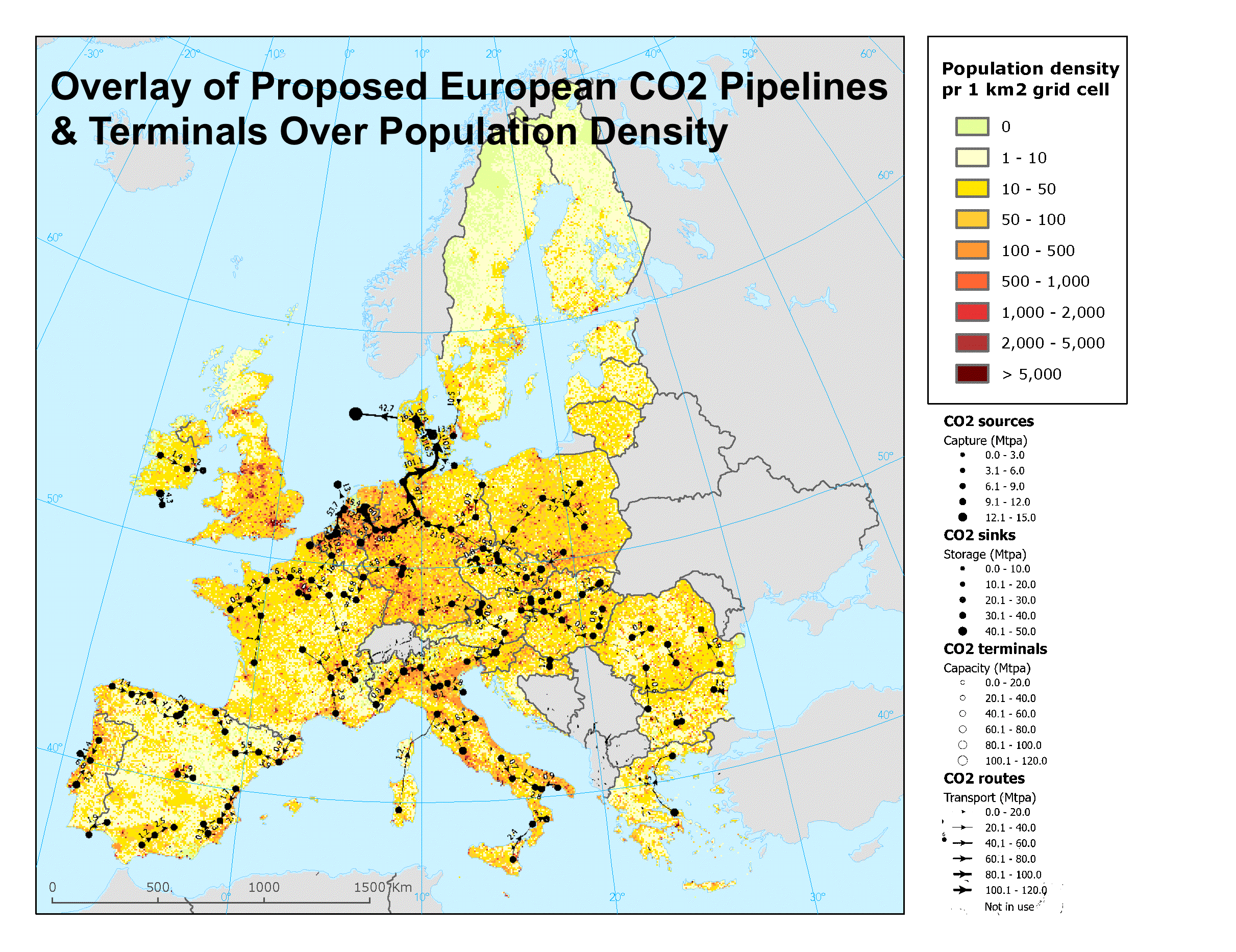
Geography and risk round out the picture. Projects with short pipes across farmland to deep saline formations are one thing. Liquid CO₂ pipelines through cities are another. Public safety, routing and emergency response for densely populated corridors are not solvable at the scales imagined by some hub proposals. Offshore storage from waterside plants avoids much of this and is the path for the North Sea rim. On-site storage under industrial plots in the right basins is the path in parts of North America. Good projects work with the map, not against it.
Cura belongs in the forward portfolio because it changes the cement chemistry. Its electrochemical route works on limestone to extract quicklime and produces a cold stream of pure, pressurized CO₂. Similar thinking applies to electrified calciners that isolate a clean CO₂ stream and to next-generation lime processes. These have the potential to make geographically lucky cement plants pencil out against the various levers reducing and substituting demand.
Future growth for CCS should target three buckets. First, fermentation and biogas clusters that store biogenic CO₂ near sinks. Second, ammonia and other chemical plants that already separate CO₂ and sit on piers or basins. Third, re-engineered process capture in cement, lime and biomethane ironmaking where the stream is clean and the storage is close.
These are coherent with a grid that is getting cleaner every year, with electrification strategies across heat, mobility and industry, and with policy that rewards real tons stored. They also build storage governance and monitoring capacity that later supports harder problems, if we still have them.
The thesis is simple. CCS is not a general climate solution. It is a narrow tool for specific flows where chemistry gives you concentration, geography gives you storage and policy gives you value. Focus there and you get real reductions at tolerable cost. Spread it thin across diffuse sources and you get cost without impact. The niches are enough to matter for ethanol, ammonia, cement and lime, biomethane steel and some biogenic streams.
Everything else should be solved by stopping the emissions at the source with clean electricity and better processes.
Subscribe to TFIE Strategy Briefing for transition analysis grounded in physics, infrastructure realities, cost denominators and practical decarbonization pathways.
Updated from an article first published by CleanTechnica.
Another great article from Michael, putting rational thought into the silliness that surrounds CCS, and the greenwashing that mis-uses it. It is possible that some (biogenic) CO2 could feed the chemical industry as starting material for formic acid.