

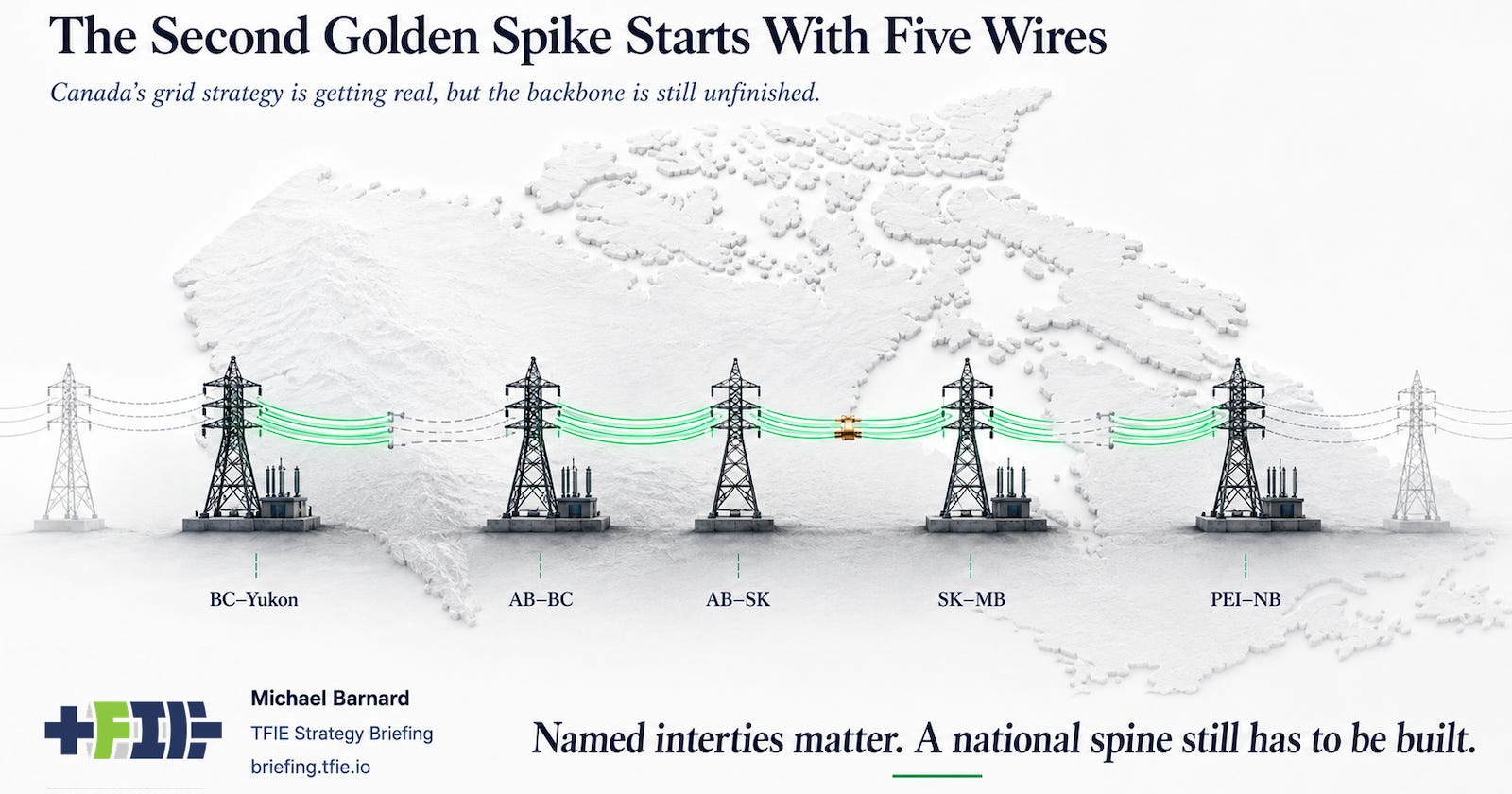
Canada’s electricity strategy has reached the point where the useful question is no longer what Ottawa intends. It is which provincial boundary a wire crosses, how much power can move across it, who pays for the asset, who owns the right to build it, and whether the line changes grid operation after it is energized.
That is why CBC’s reporting on Tim Hodgson’s priority interties matters. Canada has had no shortage of clean electricity language, nation-building language, energy-security language, affordability language and industrial-strategy language. The harder test is whether any of it turns into transmission capacity, converter stations, substations, interconnection agreements, Indigenous equity structures, permits and construction crews.
The broader federal strategy is large enough to become abstract. Reuters reported that Ottawa is talking about a C$1 trillion effort to double Canada’s electricity grid capacity by 2050, driven by industrial growth, data centers, electric vehicles and energy security. The same reporting noted the structural problem that Canada’s regional grids trade more with the United States than with each other, while U.S. electricity imports into Canada have increased every year since 2020. That is the right problem to be solving, because Canada does not have a single electricity system in any meaningful operational sense. It has provincial and regional systems with uneven resources, uneven demand growth, uneven politics and a long history of north-south trade.
I have called the needed buildout a second golden spike, but the phrase needs practical boundaries. The useful version is not one heroic coast-to-coast wire. It is a sequence of interties, upgrades, HVDC links where distance and grid conditions justify them, stronger hydro-to-fossil-province balancing, better Atlantic integration, northern diesel displacement and enough grid-enhancing work to use the existing system more effectively. The real strategy is the build order, not the patriotic and nostalgic slogan.
The reported first tranche is therefore both modest and important: BC–Yukon, Alberta–BC, Alberta–Saskatchewan, Saskatchewan–Manitoba and PEI–New Brunswick. This is not yet a national electricity spine. It is a set of useful links and repairs that begin to make the national strategy measurable. Five named interties are better than another grid strategy built around general commitments, but they should be judged as the beginning of the project, not as evidence that Canada has solved the grid problem.
The denominator is not the number of interties in a press release. It is transfer capacity, expected annual energy flow, reliability value, avoided fossil generation, exposure to U.S. imports and exports, cost allocation, permitting status, Indigenous ownership or benefit structure, and the specific bottleneck each project relieves. A transmission project that appears in a strategy is still only a strategy entry. A transmission project that changes dispatch across a provincial boundary is an electricity asset.
That is why Saskatchewan–Manitoba is the most strategically interesting of the group. Manitoba has hydro flexibility. Saskatchewan has fossil-heavy generation and large wind and solar potential. More transfer capacity between those systems can turn regional differences into system value: hydro backing variable renewables, clean surplus moving when useful, and some share of duplicated provincial backup being avoided. The value is not the line itself. The value is the operational flexibility it enables.
The other links have different tests. BC–Yukon is about northern load growth, mining, community resilience and the replacement of diesel logistics with grid electricity where that is practical. Alberta–BC and Alberta–Saskatchewan are about fossil-heavy systems, clean import options, export opportunities and the political reality that Alberta’s grid transition will be built through assets, markets and regulation, not through national averages. PEI–New Brunswick is about Maritime reliability, subsea vulnerability and whether Atlantic renewable potential becomes a grid resource rather than a long-running planning theme.
This is where the old Canadian energy frame gets in the way. Canada knows how to think nationally about pipelines, export terminals, rail corridors and ports. It is much less comfortable thinking nationally about wires, even though electrification makes wires strategic infrastructure. I have argued before that HVDC is the new pipeline, not because every intertie should be HVDC, but because long-distance energy transport increasingly shifts from moving molecules to moving electrons. The point is not the acronym. The point is the change in infrastructure priority.
That shift does not remove the delivery problem. Electricity is provincial in Canada in the legal, regulatory, operational and political senses of the word. Ottawa can finance, convene, set tax-credit rules, use the Canada Infrastructure Bank, refer projects into major-project machinery and lower the cost of capital. It still has to work through provinces, utilities, regulators, landowners, ratepayers and Indigenous governments. Those are not secondary issues around the grid. They are part of building the grid.
That is also why the first list should not be dismissed for being incomplete. A more complete national map would put Ontario–Quebec and Manitoba–Ontario closer to the center of the conversation. It would show how Atlantic wind becomes dispatchable value rather than an export brochure. It would distinguish reliability upgrades from decarbonization links, industrial-load links and northern fuel-displacement links. It would also separate transmission that requires a decade of permitting from grid-enhancing technologies that can increase useful capacity on existing corridors much faster.
The workforce and supply-chain reality is just as material. AP reported that the federal strategy anticipates 130,000 new workers will be needed to double the grid, and that the larger electricity plan still leaves major execution details to be resolved. A trillion-dollar grid strategy needs a named project pipeline, because manufacturers, utilities, training institutions and construction firms scale against procurements, standards, dates and credible financing.
The next step should be a public project ledger for each priority intertie. Capacity. Expected annual flows. Capital cost. Cost allocation. Reliability contribution. Avoided gas or diesel generation. Permitting milestones. Indigenous ownership or benefit model. Target in-service date. The bottleneck being relieved. The comparator being beaten. Without that, “priority” is a useful political signal, but not yet a delivery framework.
Canada has spent decades treating electricity as a provincial utility issue while treating fossil fuels as the national energy story. That worked politically until electrification made the grid the platform for industrial growth, household affordability, mining, data centers, transport, heating and energy security. National averages are not enough in that world. Canada’s clean electricity strengths are real, but they are unevenly distributed across hydro provinces, nuclear-heavy Ontario, fossil-heavy Alberta and Saskatchewan, wind-rich Atlantic provinces and diesel-dependent northern systems. The next energy system depends on moving more clean electricity between those systems, not just counting how clean the national average already is.
The second golden spike was never going to be a single ceremonial project. It was always going to begin as a set of interties that are easier to underrate than to build. That is fine. Serious infrastructure often starts as assets with difficult owners, difficult regulators and difficult cost-allocation arguments.
Five wires do not make a national spine. They do make the strategy harder to keep vague. Canada has started naming some of the places where the electrified economy has to cross provincial boundaries. The professional question now is whether those named links become the first tranche of a build order, or whether they remain a useful announcement in front of an unfinished grid.
Subscribe to TFIE Strategy Briefing for the professional layer behind grid and electrification claims: project denominators, comparator tests, build-order logic and decision context.
Michael, I'm in Aus right now working on the REZ/RNI transmission and generation infrastructure but will pop you a quick text as a follow up. Good article. Very good comprehensive and economical summaries.
I've been promoting the first of these named interties to be facilitated by the Federal and FN which sits on top of the provincial systems. It is the WCISO between eastern BC through to Winnipeg. Western Canadian Independent System Operator sponsored and co-owned by FN with the other provincial incumbents. HVDC links anchored by our 4 GW PSH in eastern BC through to Wabamum west of Edmonton, upgrade AB HVDC lines to Langdon, another line to Regina, and then to Winnipeg.
The US ISO's provide a suitable working model for capitalization and operations. Ive worked in the NEISO system.
This would provide 3-4 GW transfer capacity between the provinces.