

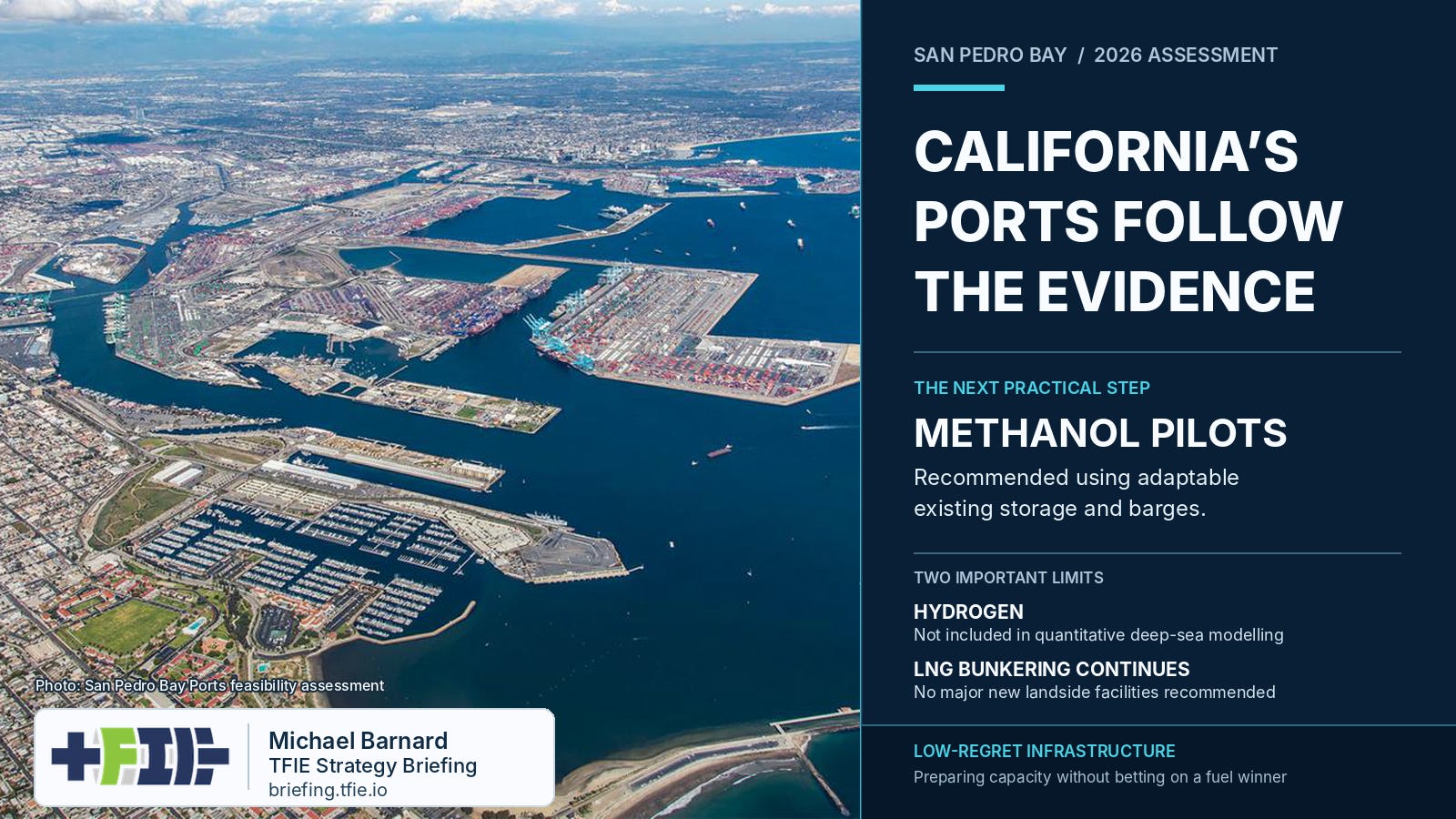
California has spent much of the past two decades promoting hydrogen for transportation, investing in everything from passenger vehicles and buses to trucks, port equipment and fuel production. The state has been one of the world’s centres of hydrogen enthusiasm, supported by government agencies, research institutions, manufacturers and substantial public funding. That’s why the latest marine fuel assessment from the Ports of Los Angeles and Long Beach is such an interesting development. The two ports have explicitly excluded hydrogen from their detailed assessment of future deep-sea shipping fuel demand and infrastructure requirements.
That isn’t a rejection of hydrogen for every application at the ports, and it isn’t a reversal of California’s hydrogen policies. Hydrogen fuel cells remain under consideration for some terminal equipment. But for oceangoing shipping, the two ports have looked at commercial readiness, shipping-line investments, fuel availability and infrastructure requirements, and concluded that hydrogen doesn’t warrant inclusion in their quantitative planning. It’s an evidence-based decision from institutions operating in a state where evidence hasn’t always prevailed over hydrogen ambitions.
The Clean Marine Fuel Feasibility Assessment, released in October 2026, contains two other recommendations that deserve equal credit. The Ports intend to continue accommodating LNG-powered ships without constructing major new LNG storage or liquefaction infrastructure. They also recommend developing methanol bunkering through existing liquid-fuel infrastructure, limited investments and commercial demonstrations. Together, these are sensible choices that preserve flexibility without committing enormous amounts of capital to uncertain fuel markets.
The underlying work is substantial. Beginning with a December 2024 white paper, the researchers examined hydrogen, methanol, ammonia, renewable LNG and biofuels. Subsequent reports examined international fleet orders, regulatory developments, competing ports, vessel calls, shipping-line preferences and fuel supply chains. The project contacted 38 shipping lines and received responses from 19, supplemented by interviews with operators and fuel suppliers. Among the surveyed carriers, 13 were exploring or committed to LNG, 13 to biofuels, nine to methanol, five to ammonia and only one to hydrogen.
Those responses didn’t determine the recommendations by themselves. The research also examined technology readiness, handling requirements, supply availability and the actual vessels operating through San Pedro Bay. In 2024, the ports recorded 3,963 vessel calls, including 189 by LNG-capable ships and seven by methanol-capable ships. The researchers then considered what existing and announced fleets might require by 2030. Hydrogen was not a commercially meaningful contender for deep-sea bunkering on that evidence.
That matches what I’ve found in years of assessing maritime hydrogen projects. Hydrogen can propel ships, just as it can propel trucks, buses and trains. Demonstrating propulsion isn’t the difficult part. The challenge is assembling an economical, reliable system of fuel production, compression or liquefaction, transportation, storage, bunkering and onboard conversion that competes with available alternatives. Deep-sea vessels magnify hydrogen’s poor volumetric energy density and infrastructure disadvantages. Batteries are increasingly viable for inland and short-sea shipping, while conventional liquid fuels retain substantial advantages for transoceanic operations. Excluding direct hydrogen from near-term deep-sea infrastructure planning is appropriate.
The LNG recommendation is almost as interesting. The September 2025 viability report initially contemplated dedicated LNG storage at San Pedro Bay. By the final assessment, after examining West Coast supply chains and demand, the recommendation had become much more restrained. Continue enabling ship-to-ship LNG bunkering, but avoid major new landside LNG infrastructure. Existing deliveries from British Columbia demonstrate that LNG bunkering can occur, while potential Mexican supply could eventually shorten the delivery route. Neither justifies an expensive new LNG terminal in the harbour.
The supply-chain analysis makes the economics understandable. California lacks the marine-accessible liquefaction and storage infrastructure needed for a large local LNG bunkering industry. New US-flagged cryogenic bunker vessels could cost $120 million to $150 million each. LNG handling requires specialized equipment, permitting and safety procedures. Meanwhile, the market for LNG bunkering at San Pedro Bay is uncertain, and ships serving the ports already obtain much of their fuel elsewhere on their international service rotations. Building permanent infrastructure around optimistic forecasts could create assets that struggle to recover their costs.
I remain unconvinced by the characterization of fossil LNG as a meaningful climate transition fuel. It can improve local air quality by reducing sulfur oxides and particulate emissions, and suitable engines can lower nitrogen oxides. Those benefits matter to communities near the ports. But methane leakage during production and transportation, along with methane slip from marine engines, can substantially erode or eliminate lifecycle greenhouse gas advantages. Renewable biomethane is constrained in supply and commands a premium. The Ports recognize those problems, even while continuing to describe LNG as a transition fuel. Their decision to avoid major permanent LNG investment is stronger than their climate case for LNG itself.
Methanol provides a useful contrast. It is a liquid at ambient temperature and pressure, already handled by an established global chemical industry. Storage tanks, loading facilities and liquid-cargo barges can often be adapted with relatively modest modifications. The assessment identifies an existing storage asset at Long Beach with approximately 70,000 barrels of usable capacity that could potentially be repurposed. It estimates that converting an existing barge for methanol service could cost $700,000 to $1 million. Neither figure establishes a complete commercial bunkering system, but both demonstrate why methanol is a relatively inexpensive option to prepare for.
The Port of Long Beach has already approved a $1 million incentive for the first commercial methanol bunkering operation, with a minimum delivery of 2,000 metric tons. The joint Ports’ assessment recommends going further, establishing recurring bunkering operations that can test permitting, logistics, safety, fuel delivery and actual customer demand. That’s important. A ceremonial first delivery proves technical feasibility. Repeated deliveries at commercially supportable prices establish whether a market exists.
I’ve argued for some time that biomethanol is likely to be an important residual fuel for deep-sea shipping, especially as inland vessels, short-sea shipping and harbour craft electrify. Methanol’s advantages as an energy carrier are real, and its compatibility with existing infrastructure reduces transition risk. Future hybrid ships could use batteries and electric propulsion for manoeuvring, ports and shorter journeys, with methanol or ethanol generating electricity where longer-range liquid-fuel energy remains necessary. The Ports’ approach creates infrastructure compatible with that future without requiring it to emerge on a particular schedule.
These are genuinely good decisions. The researchers haven’t tried to manufacture a use case for hydrogen, haven’t recommended building an expensive LNG system because shipping companies have already ordered LNG vessels, and haven’t called for a large new methanol terminal on the strength of an optimistic demand forecast. They have identified practical steps that preserve options and limit the consequences of getting the future wrong. More infrastructure planning should look like this.