

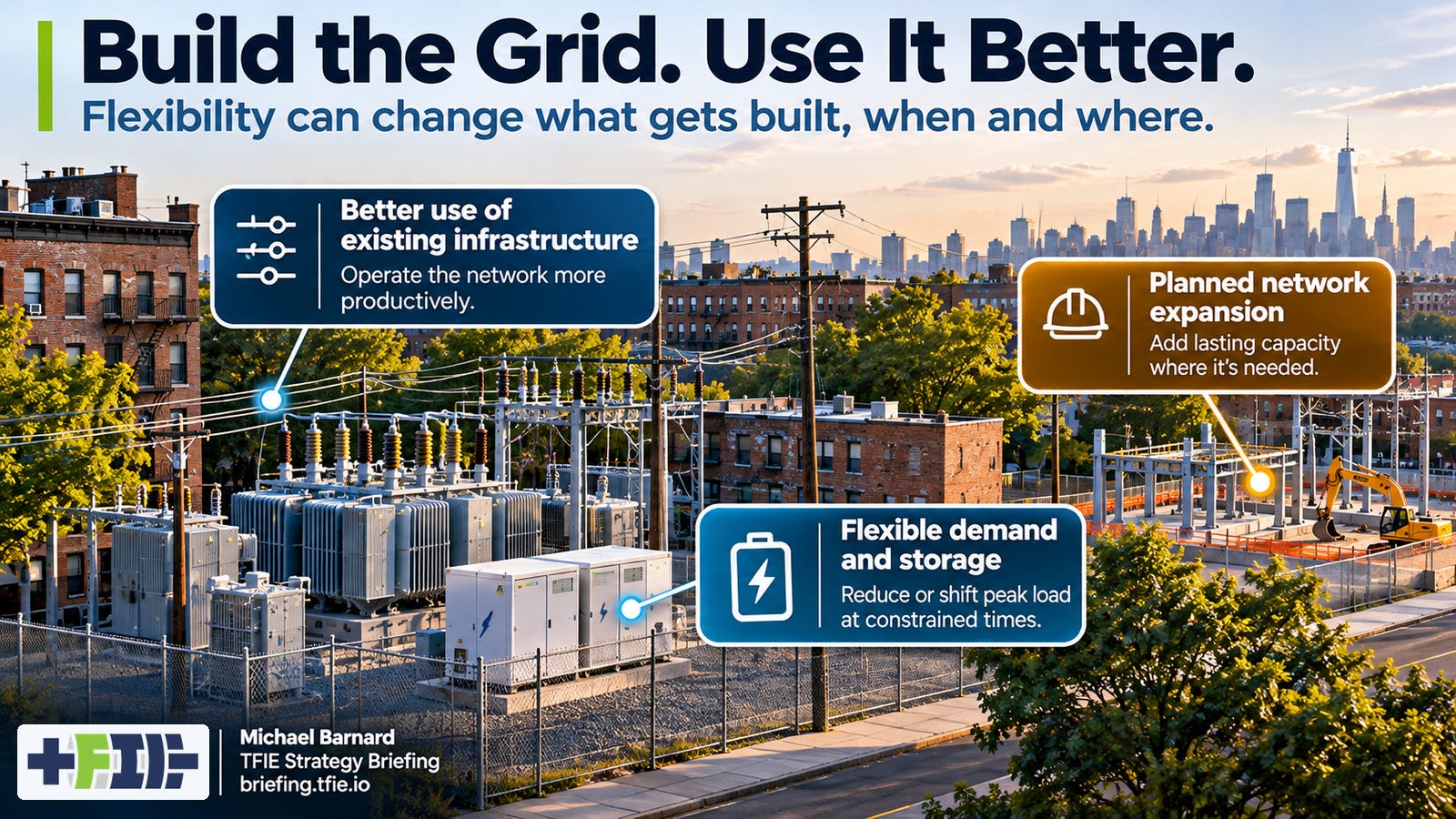
In Brooklyn and Queens, New York’s electricity utility faced a familiar problem. Growing demand was pushing parts of its distribution network toward their capacity limits. The conventional answer involved new substations, transformers, feeders and other infrastructure, with costs running into the hundreds of millions of dollars. The alternative involved paying customers to improve efficiency, installing batteries, adjusting voltage and combining those interventions with conventional network work.
Con Edison’s Brooklyn/Queens Demand Management programme became one of the most frequently cited examples of avoiding expensive grid construction through flexibility. More than a decade after it began, its regulatory filings provide a more useful account than the promotional version. They show what was achieved, how much was spent, which infrastructure remained necessary and where similar alternatives subsequently failed the investment test.
By the first quarter of 2026, the programme had delivered 63.4 MW of peak-hour load relief at a cumulative expenditure of $160.91 million, against an authorized budget of $200 million. Of the relief, approximately 44.9 MW came from customer-side measures and 18.5 MW from utility-side measures, including 17 MW of conservation voltage optimization and 1.5 MW of battery storage. A further 5.8 MW battery near Brownsville Substation had been constructed in 2025 but was still awaiting operating approvals at the time of the report. Con Edison excluded it from delivered capacity.
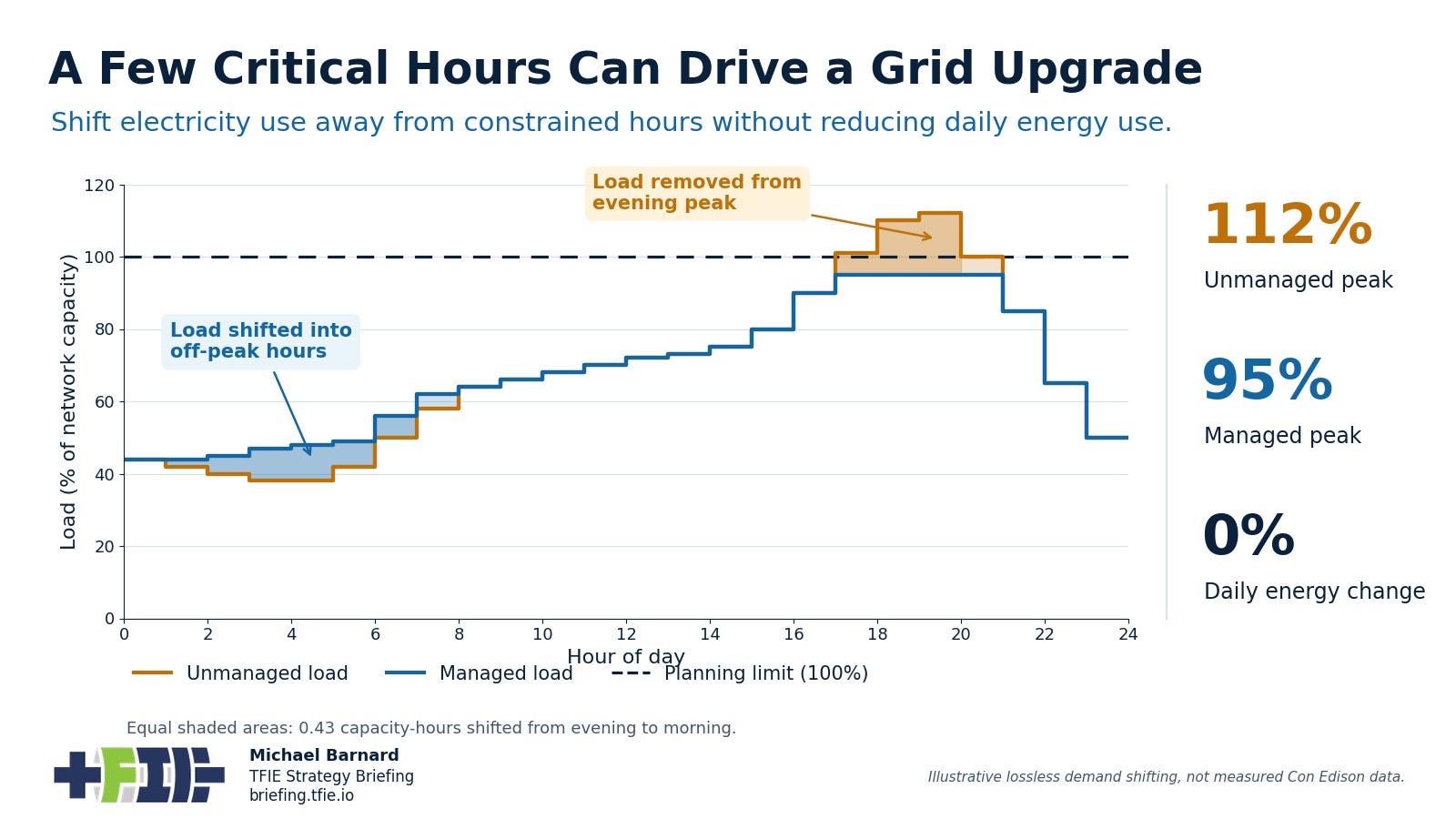
Electricity networks are designed to accommodate peak demand, not average consumption. A feeder or transformer might operate below its rating for much of the year yet require reinforcement because a handful of demanding hours threaten to overload it. Reducing enough demand during those hours can change an investment decision. A smaller intervention may provide years of useful capacity, allowing the utility to postpone construction until growing demand justifies it.
The original Brooklyn/Queens plans combined approximately 52 MW of non-traditional load relief with 17 MW of conventional solutions. The broader infrastructure expansion against which the programme was developed was estimated at roughly $1 billion or more. That comparison helped establish the programme’s reputation, but it also encouraged an overly generous interpretation of the financial outcome.
Con Edison did not permanently eliminate a billion-dollar construction programme by spending $161 million. It deferred elements of the proposed expansion, changed its configuration and incorporated conventional investments where necessary. The financial benefit of deferral depends on its duration, the cost of capital, the expenditure required to maintain reliability in the interim and changes to the eventual construction project.
Consider a simplified example. At a 5% real discount rate, postponing a $1 billion investment with the same real construction cost by five years reduces its present value to approximately $784 million. The financial value of deferral is $216 million before accounting for the cost of the interventions that make it possible. That is an illustrative calculation, not an estimate of Con Edison’s savings. The utility has also reported no quantifiable operational savings in its sub-transmission and distribution operations directly attributable to the Brooklyn/Queens programme.
The programme’s interventions were practical. Con Edison supported efficiency improvements in apartment buildings, businesses and public facilities, including lighting, heating and cooling equipment and controls. Conservation voltage optimization reduced consumption by managing distribution voltage within acceptable operating limits. Batteries moved electricity between periods, while customer-side generation contributed additional relief. Much of the result came from efficiency and voltage management rather than dispatchable batteries or automated demand response. The evidence supports a portfolio of interventions, not a particular flexibility technology.
Which flexibility projects avoided construction, which merely deferred it, and which failed the test? How much capacity could better grid operation unlock, and how should utilities and regulators choose between the alternatives? The rest of this Briefing examines the project evidence, global potential and investment framework.