

A Belgian contact pointed me to a LinkedIn post that made a simple denominator claim: Belgium had eight hydrogen refuelling stations for only 94 hydrogen cars. That was enough to get me interested, not because LinkedIn posts are evidence, but because denominators are where weak infrastructure stories usually go to die. The post was imprecise in small ways. They are hydrogen refuelling stations, not petrol stations, and the better open-data figure from the European Hydrogen Observatory is closer to 109 registered hydrogen passenger cars in 2024. But the correction does not rescue the business case. It makes the claim more precise, not less damning.
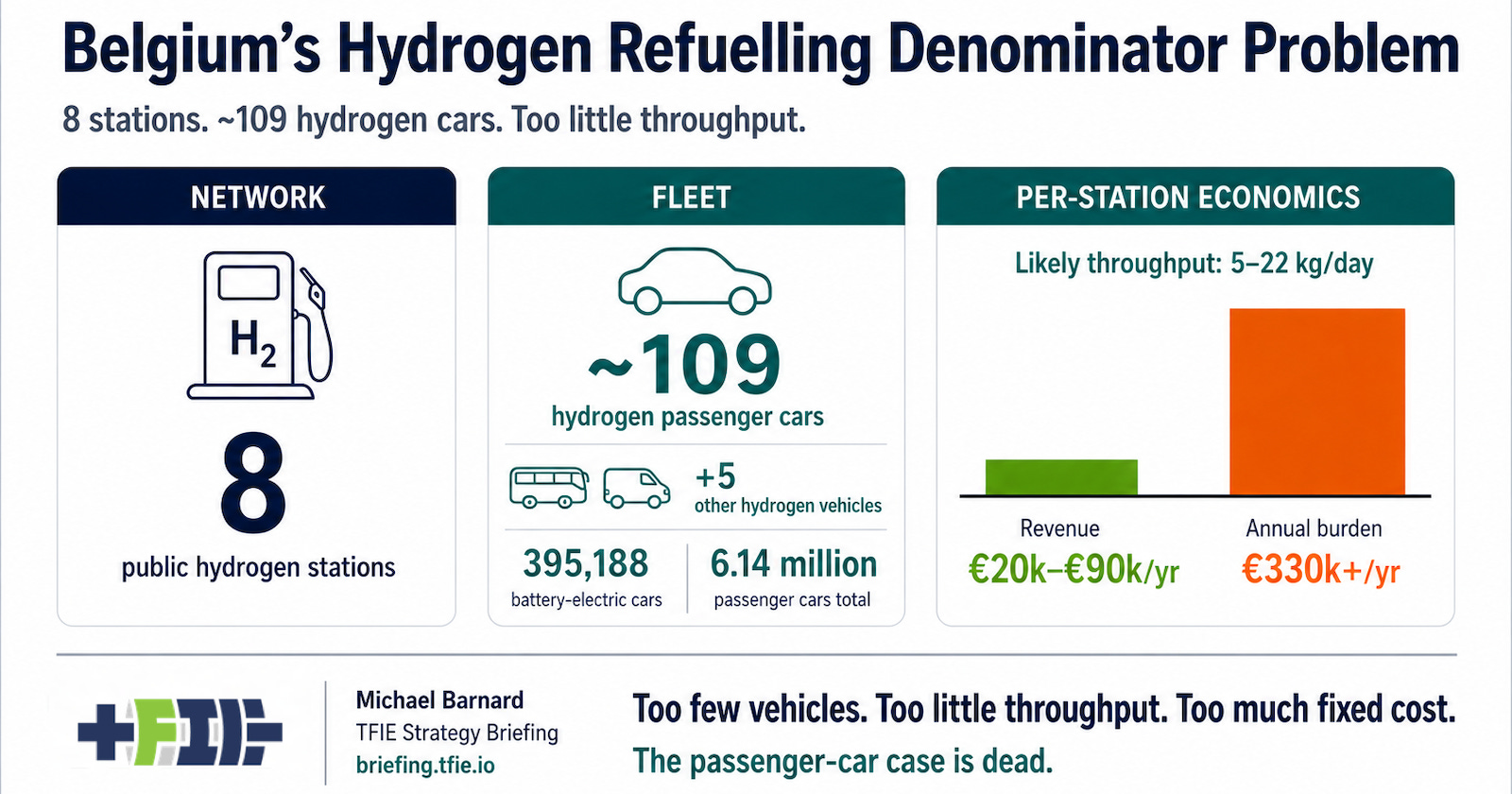
Belgium has eight public hydrogen refuelling stations, roughly 109 hydrogen passenger cars, and a tiny number of other hydrogen road vehicles. The same country had about 395,000 battery-electric passenger cars and 6.14 million passenger cars overall in Statbel’s 2025 vehicle stock. Hydrogen passenger cars are about one for every 3,600 battery-electric cars. That is not an early market. That is a rounding error hiding inside another rounding error, and the useful question is what eight hydrogen refuelling stations can earn when the road fleet they can serve is that small.
Belgium was not uniquely irrational. In the 2010s, hydrogen mobility plans across Europe had a familiar structure. Build stations. Seed cars. Demonstrate buses. Announce corridors. Assume cost declines. Assume fleets will buy. Then repeat the assumptions until they look like a strategy. Belgium’s earlier hydrogen mobility planning expected 1,000 fuel-cell cars and 50 hydrogen buses by 2020, then 7,500 cars and 250 buses by 2025. At those volumes, a hydrogen refuelling network looks at least arithmetically plausible. Those volumes did not arrive.
The passenger car market went battery-electric. Belgium’s hundreds of thousands of electric cars are not waiting for a new molecule supply chain, 700 bar compression, chillers, tube trailers, electrolyzers, special dispensers, scarce service technicians, and a retail fuel price that still makes diesel look emotionally well adjusted. They plug in, and the system is scaling. Hydrogen passenger cars did not. Toyota and Hyundai built real cars, but not a real market. Consumers looked at vehicle choice, fuel availability, fuel price, resale risk and infrastructure fragility, and mostly bought something else. Of course they did.
There is an important nuance. The “eight stations for roughly a hundred cars” line is incomplete because some Belgian hydrogen stations support 350 bar, not just 700 bar. Some are dual-pressure sites aimed partly at heavy-duty, logistics, port or industrial uses. The H2Benelux station list shows a mixed network, while CMB.Tech’s Antwerp facility is better understood as a hydrogen logistics installation than as a simple roadside car pump. That distinction matters, because a 350 bar dispenser can serve some buses, trucks, refuse vehicles, port equipment and other commercial applications, assuming the site has the access, storage, flow rate and reliability to handle them.
Nuance is not exoneration. It just moves the question. If the stations are not justified by hydrogen cars, where are the buses and trucks that justify them? The answer is that they are mostly not there either. Recent European fleet data showed only a handful of non-passenger hydrogen vehicles in Belgium, including four buses or coaches and one van. Flanders’ De Lijn has since ended its hydrogen bus operations, retiring its small Van Hool fleet and dismantling the associated refuelling station, according to Flemish Parliament material. Brussels tested hydrogen and did not scale. Wallonia appears to have mostly avoided the hydrogen bus detour and is moving down the battery-electric depot path.
That is the recurring pattern. Passenger cars did not arrive. Transit buses tried hydrogen in places and mostly learned not to do that again. Heavy trucks remain a pilot category, not a utilization base for a public refuelling network. Hydrogen stations are paid for by kilograms moving through compressors, storage tanks, cooling systems, dispensers and payment terminals. Belgium does not have enough kilograms.
The exact vehicle count will move a little, but the order of magnitude is the story. A realistic passenger-car assumption might be around 120 kilograms of hydrogen per car per year. With 109 cars, Belgium’s passenger hydrogen demand would be about 13,000 kilograms per year. Spread across eight stations, that is about 1,600 kilograms per station per year, or about 4.5 kilograms per station per day. That is not station utilization. That is a rounding error with a nozzle.
Use the more generous planning assumption of 250 kilograms per car per year, and the passenger-car market rises to about 27,000 kilograms per year nationally. Spread across eight stations, that is about 9 kilograms per station per day. Better, in the way that a teaspoon is better than a drop when the task is filling a bathtub. Add the old bus stock, using the planning assumption of 8,000 kilograms per bus per year. Four buses would add 32,000 kilograms per year. Passenger cars plus those buses would get Belgium to roughly 59,000 kilograms per year, or around 20 kilograms per station per day. But this is already generous because the Flemish hydrogen buses have been retired.
Push harder and imagine total road-vehicle demand around 100,000 to 110,000 kilograms per year from early heavy-duty pilots and special vehicles. Across eight stations, that is about 35 to 40 kilograms per station per day. That is still weak. Aberdeen’s Kittybrewster hydrogen station was designed around 360 kilograms per day. Actual reported throughput was about 40,000 kilograms per year, or about 110 kilograms per day across the year. That was already weak enough to make the economics collapse under operating and capital cost. Belgium’s average station appears likely to be far below even that.
DATS 24’s reported Belgian hydrogen price has moved from €9.99 per kilogram to €11.98 per kilogram, according to coverage of the DATS 24 increase. That sounds high to drivers, and it is. For the station operator, however, the problem is not that the price is low. The problem is that there are not enough kilograms to sell. At 4.5 kilograms per day per station, annual revenue is about €20,000. At 9 kilograms per day, it is about €41,000. At 20 kilograms per day, it is about €89,000. At 38 kilograms per day, a generous heavy-use case, revenue reaches about €165,000.
Those numbers are revenue, not gross margin. Hydrogen still has to be produced or purchased, compressed, delivered or made on site, stored, chilled, dispensed, metered, maintained and insured. The station still needs inspections, service contracts, uptime support, power, land, safety systems and capital recovery. Hydrogen refuelling equipment is a small industrial installation pretending to be retail convenience. H2 Mobility’s public material puts a small 700 bar station integrated into a conventional filling station at roughly €1.2 million, while larger commercial-vehicle 350 bar stations are estimated around €2.5 million. Those are capital costs before the ongoing burden begins.
My prior work on real-world hydrogen refuelling economics keeps finding the same shape. Germany’s hydrogen refuelling network looked impressive until utilization math showed station revenue in the tens of thousands against operating costs in the hundreds of thousands. Aberdeen’s Kittybrewster station had reported operating costs of roughly £325,000 per year on an asset that cost about £1 million. California’s hydrogen stations have had their own version of the same disease.
A Belgian station selling €20,000 to €90,000 of hydrogen per year is not merely underused. It is commercially absent. Even with a forgiving cost stack, the annual operating burden alone can be several hundred thousand euros. Add capital recovery and hydrogen supply costs, and the gap becomes a canyon with safety fencing. This is the core denominator problem. Revenue is in tens of thousands. Costs are in hundreds of thousands. The denominator is kilograms, and there are not enough of them.
There is a defensible version of early hydrogen mobility support. A decade ago, it was not crazy for governments and companies to run a few pilots. Fuel-cell cars existed. Fuel-cell buses existed. Battery-electric buses were less mature. Long-range charging networks were thinner. Heavy-duty electrification was less obvious to many decision makers. Industrial hydrogen was already real, at least as a fossil-derived input. A small number of pilots can be defended as learning expenditure, but learning expenditure has to learn.
Passenger cars went battery-electric. Transit buses went battery-electric. Distribution fleets are going battery-electric. Depot charging keeps improving. Hydrogen retained niches in slide decks and pilot programmes, but the mass-market pathway kept receding. At some point, option value becomes infrastructure inertia. Assets exist, so they need a story. Subsidies were awarded, so they need a policy frame. Corporate strategies were announced, so they need continuity. A few trucks or refuse vehicles appear, so they are asked to carry the narrative weight of an entire fuel chain. That is not strategy. That is sunk cost with a press release.
The Zeebrugge hydrogen project should not be lazily collapsed into “more hydrogen stations for cars.” Hyoffwind is a 25 MW electrolyser project intended for industry, transport and potential injection into the gas network. It has different assets, different offtakers, different policy arguments and a different denominator. Industrial hydrogen should be assessed as industrial hydrogen. Does it displace existing gray hydrogen? Does it have firm offtake? What is the delivered cost per kilogram? What is the electrolyzer utilization? What electricity is it using, at what price, and with what grid consequences?
Those are the right questions, but Zeebrugge does not rescue the road refuelling story. If hydrogen is being justified for industry, judge it against industrial hydrogen demand and fossil hydrogen displacement. If it is being justified for transport, show the vehicles, kilograms and utilization. Hydrogen keeps getting into trouble when one use case borrows credibility from another. Industrial feedstock demand is used to justify transport infrastructure. Transport pilots are used to justify electrolyzers. Electrolyzers are used to justify renewable integration claims. The chain looks impressive until someone asks which part is paying for which asset.
The LinkedIn post that prompted this was not evidence by itself. It was a useful pointer to a denominator worth checking. The original claim used the wrong label for the stations, gave a hard vehicle count where a rounded figure is safer, and did not acknowledge that some Belgian hydrogen stations can serve 350 bar commercial vehicles as well as 700 bar cars. Correct all of that, and the conclusion gets harsher, not softer. Belgium has eight public hydrogen refuelling stations, roughly 109 hydrogen passenger cars, a tiny number of other hydrogen road vehicles, about 395,000 battery-electric passenger cars, and a public station network whose average road-vehicle throughput is likely measured in single-digit to low-double-digit kilograms per day.
Hydrogen advocates often say infrastructure has to come first. Sometimes that is true, but infrastructure that comes first still has to be followed by customers. Belgium built visible pieces of a hydrogen mobility network. The customers mostly did not arrive. Battery-electric vehicles did. The laws of physics do apply in Halle. In this case, the laws of arithmetic are even harsher. Too few vehicles. Too little throughput. Too much fixed cost. Belgium’s hydrogen refuelling network may have option value for a few industrial and heavy-duty experiments, but the passenger-car case is dead, and the heavy-duty case is still too small to carry the assets.
Paid subscribers to Michael Barnard’s TFIE Strategy Briefing get the professional layer behind selected analyses: source notes, calculation tables, reality ledgers, expanded infographics, and the questions I would ask before capital, policy, procurement, or reputation gets committed.
This article is a small example of the method. A Belgian contact pointed me at a claim that was directionally interesting but needed checking. The useful work was not treating the LinkedIn post as evidence, but testing the denominator against registrations, station capabilities, comparable station economics, bus experience and battery-electric adoption. That is where weak infrastructure stories tend to reveal themselves, and it is the work that belongs behind serious decisions.