

The aviation industry describes itself as a powerful engine of economic growth. IATA says aviation supports 86.5 million jobs, generates $4.1 trillion in economic activity and accounts for 3.9% of global GDP. It presents connectivity as a force that stimulates tourism, trade, investment and activity throughout the wider economy. Those are substantial numbers, and the activity behind them is real. But they describe aviation’s economic footprint. They do not demonstrate that every additional passenger journey causes additional economic growth.
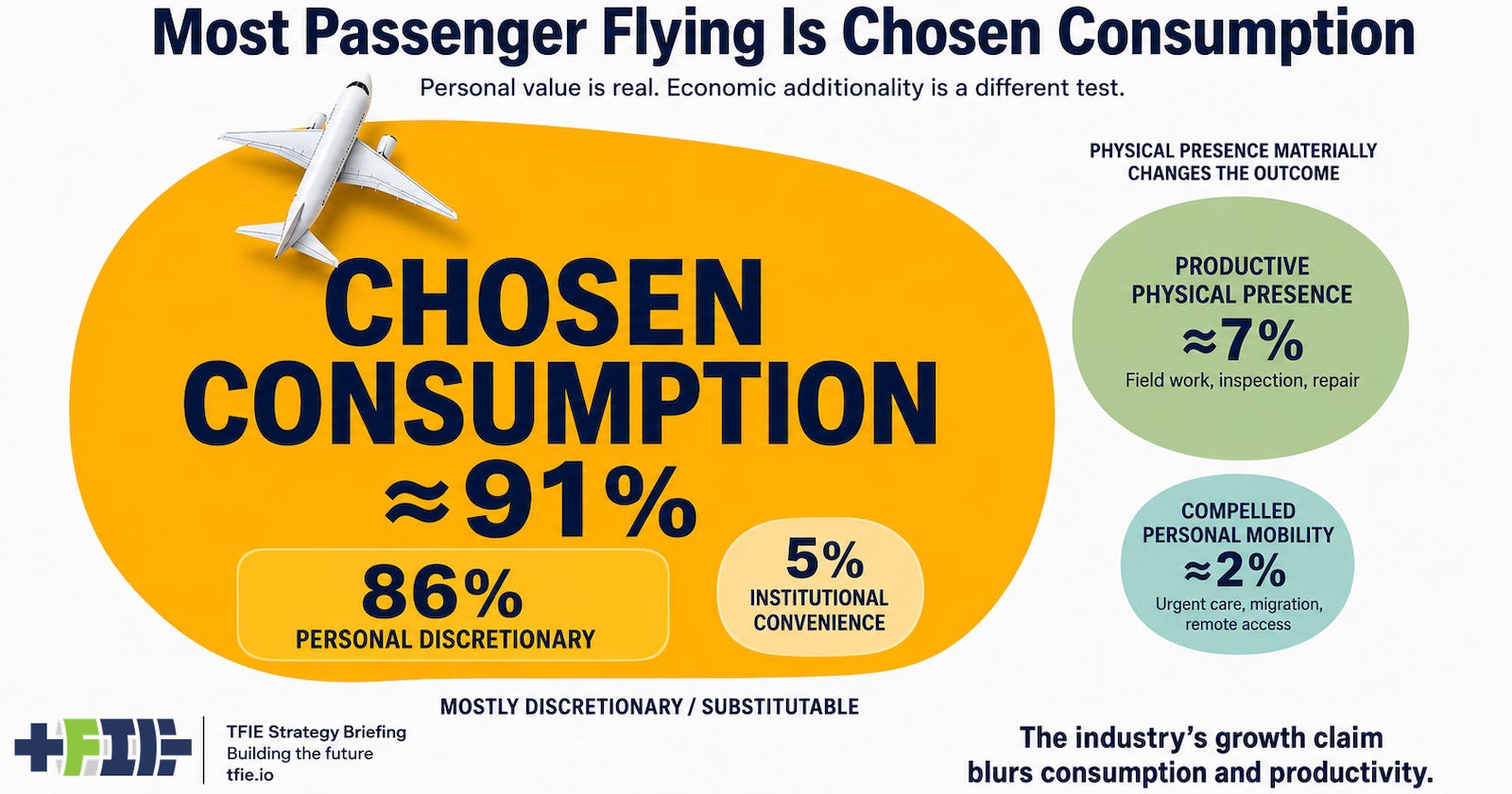
I am not making that distinction from the moral high ground. This year, my spouse and I are flying to the UK and Ireland for a six-week holiday. I am placing myself squarely inside the largest part of that 91% chosen-consumption field, the 86% illustrative share assigned to discretionary personal travel. The trip will have considerable personal value, and we will spend money in hotels, restaurants, museums, cafés, trains and pubs. But I do not have to take it, and my enjoyment does not turn the flight into a productivity programme. It is discretionary consumption by someone who can afford to cross an ocean for pleasure.
The precise global division of passenger journeys by purpose is surprisingly poorly documented in public data. A 2024 UK Civil Aviation Authority survey covering eight major airports found business travel at 13%, down substantially from 2019, while the familiar estimate that corporate travellers represent about 12% of air traffic is actually a widely cited pre-COVID benchmark. That makes an illustrative 88% personal and 12% institutional split reasonable for a stress test, but purpose is not the same thing as economic additionality. The graphic puts 86% of passenger journeys into personal discretionary travel and another 5% into institutional convenience: routine meetings, conferences, delegations and similar journeys where the objective could often be achieved another way. Together, those form the roughly 91% chosen-consumption field. The remaining illustrative 9% consists of 7% productive institutional presence and 2% compelled personal mobility. Those subdivisions are analytical allocations, not measured global statistics.
That makes an 88% personal and 12% institutional split reasonable for an approximation of current passenger aviation. The graphic divides that further into 86% chosen personal consumption, 2% compelled personal mobility, 7% productive institutional presence and 5% institutional convenience. Those four figures are not well measured global statistics, because they look starkly bad when presented this way. They are model estimates of the reality of passenger travel based on the best available data.
The test is simple: what would happen if the flight did not occur? The counterfactual is rarely a traveller sitting motionless in a dark room, generating no economic activity. Money might be spent on a closer holiday, restaurants at home, renovations, consumer goods, savings or investment. A meeting might move online. One employee might travel instead of six. A local contractor might perform the work, or three objectives might be combined into one less frequent trip.
This is the language of additionality, deadweight, substitution, displacement and leakage. The UK Treasury’s Green Book requires public investments and policies to be assessed against what would have occurred anyway. It recognizes that jobs and activity may move between sectors or locations rather than appearing from nowhere. Gross output and employment counts do not, by themselves, answer the causal question.
Tourism illustrates the distinction. My spending on accommodation, restaurants, domestic transport and attractions in the UK and Ireland will be recorded as travel-services exports by those economies. In an island state with spare capacity, few alternative exports and locally owned tourism businesses, air access may generate highly additional income. In London, Dublin or Edinburgh during peak season, visitors also compete for accommodation, workers, restaurant capacity and infrastructure that have other potential users.
Some tourist spending remains local. Some leaks through foreign airlines, booking platforms, imported goods and external ownership. Some replaces domestic tourism or consumption elsewhere. Tourism spending is real economic activity, but treating all of it as net additional global growth skips the counterfactual.
Some institutional travel belongs outside that chosen-consumption field because physical presence materially changes the outcome. Equipment commissioning, field inspection, specialist repair, emergency response and site-specific due diligence require people to interact with actual assets and locations. Tacit knowledge can be hard to transfer through a screen, and some negotiations or diplomatic interactions improve materially when people share a room.
Other institutional flying belongs economically in the same chosen-consumption field as discretionary personal travel, even though an organization rather than a household pays the bill. Routine internal reviews, generic conferences, oversized delegations, status visits, remotely deliverable training and repeated account meetings may carry approved business or government purposes without creating enough additional value to require physical travel. They are not personal leisure, but they are still chosen, substitutable consumption of aviation services. An expense code proves that an organization paid for the journey. It does not prove that the journey made the organization more productive.
OVID provided the closest thing aviation has had to a global natural experiment in that distinction. Companies moved internal meetings, conferences, preliminary sales discussions and routine oversight online almost overnight, and much of the underlying work continued. McKinsey subsequently estimated that about 20% of business travel might never recover as virtual meetings replaced in-person ones. Its more detailed segmentation put only about 15% of 2019 corporate travel spending in a category where travel was considered essential, including field operations and managers responsible for distributed physical assets, while about one-fifth sat in a segment particularly amenable to permanent reduction through digital tools and local oversight. The experiment did not prove that business travel was unnecessary. It demonstrated that an identifiable layer of institutional flying could disappear without the economic purpose disappearing with it.
Much of corporate travel has since returned, which is not proof that every returning journey passed an additionality test. McKinsey identified a much larger “fear of missing out” category in which competitive behaviour could pull travel back because clients and rivals were travelling again. That can make a trip individually rational for a company while leaving open whether the industry-wide increase in flying creates equivalent net productivity. Business travellers are exceptionally valuable to airlines because they tend to buy flexible and premium fares and book closer to departure. Before COVID they represented only about 12% of traffic but accounted for roughly half of US airline-sector profitability. High value to the airline is not the same thing as high additional value to the economy.
The construction of the industry’s $4.1 trillion headline makes the distinction clearer. Aviation: Benefits Beyond Borders attributes roughly $1.1 trillion to direct aviation activity, with the remainder assigned to aviation suppliers, spending by aviation and supplier employees, and tourism enabled by air travel. Only about one-quarter of the total is direct aviation output.
None of those associated activities is fictitious. Aircraft require maintenance, airports purchase services, workers buy groceries and tourists book rooms. But nurses, software engineers, grid technicians and railway workers also buy groceries. Counting household spending demonstrates that wages circulate through the economy. It does not demonstrate that aviation uniquely created that spending, that the workers would otherwise be unemployed or that increasing passenger traffic is the highest-value use of labour, capital, infrastructure and energy.
Aviation does have powerful economic functions. It connects isolated communities and island economies. It moves urgent, perishable and high-value cargo. It enables emergency mobility, physical work at distant sites and selected transfers of knowledge, trust and expertise. A first reliable connection to a remote economy is not economically equivalent to adding another low-cost frequency between two affluent cities that already have multiple routes.
The strongest version of the aviation case is therefore narrower than the industry’s aggregate messaging. Aviation can enable economic growth without every flight being an economic growth engine. Some connections unlock activity that would otherwise be impossible. Others primarily serve consumption made possible by income and productivity created elsewhere.
This distinction becomes operationally important once aviation has to pay for decarbonization. Today’s passenger network was built around abundant, inexpensive kerosene. Sustainable aviation fuels, synthetic fuels, lifecycle requirements and carbon costs make longer-distance liquid-fuel aviation more expensive. Shorter routes face a different emerging cost structure because electric and hybrid-electric aircraft can use much cheaper energy where range, payload and reserve requirements allow them to compete.
Those pressures do not affect every journey equally. Urgent mobility, physical work and the highest-value interactions are relatively sticky. Marginal holidays, routine meetings, generic conferences and other price-sensitive journeys are more exposed to changes in destination, frequency, mode or whether the trip happens at all.
The distinction becomes operationally important once aviation has to pay for decarbonization. Today’s passenger network was built around abundant, inexpensive kerosene. Sustainable aviation fuels, synthetic fuels, lifecycle requirements and carbon costs make longer-distance liquid-fuel aviation more expensive. Shorter routes face a different emerging cost structure because electric and hybrid-electric aircraft can use much cheaper energy where range, payload and reserve requirements allow them to compete. Those pressures do not affect every journey equally. Urgent mobility, physical work and the highest-value interactions are relatively sticky. The enormous chosen-consumption field is much more exposed to price, frequency and alternatives, whether that means taking a closer holiday, travelling less often for longer, combining several business purposes into one trip, shifting to rail or video, or simply deciding that a particular journey is no longer worth its price.
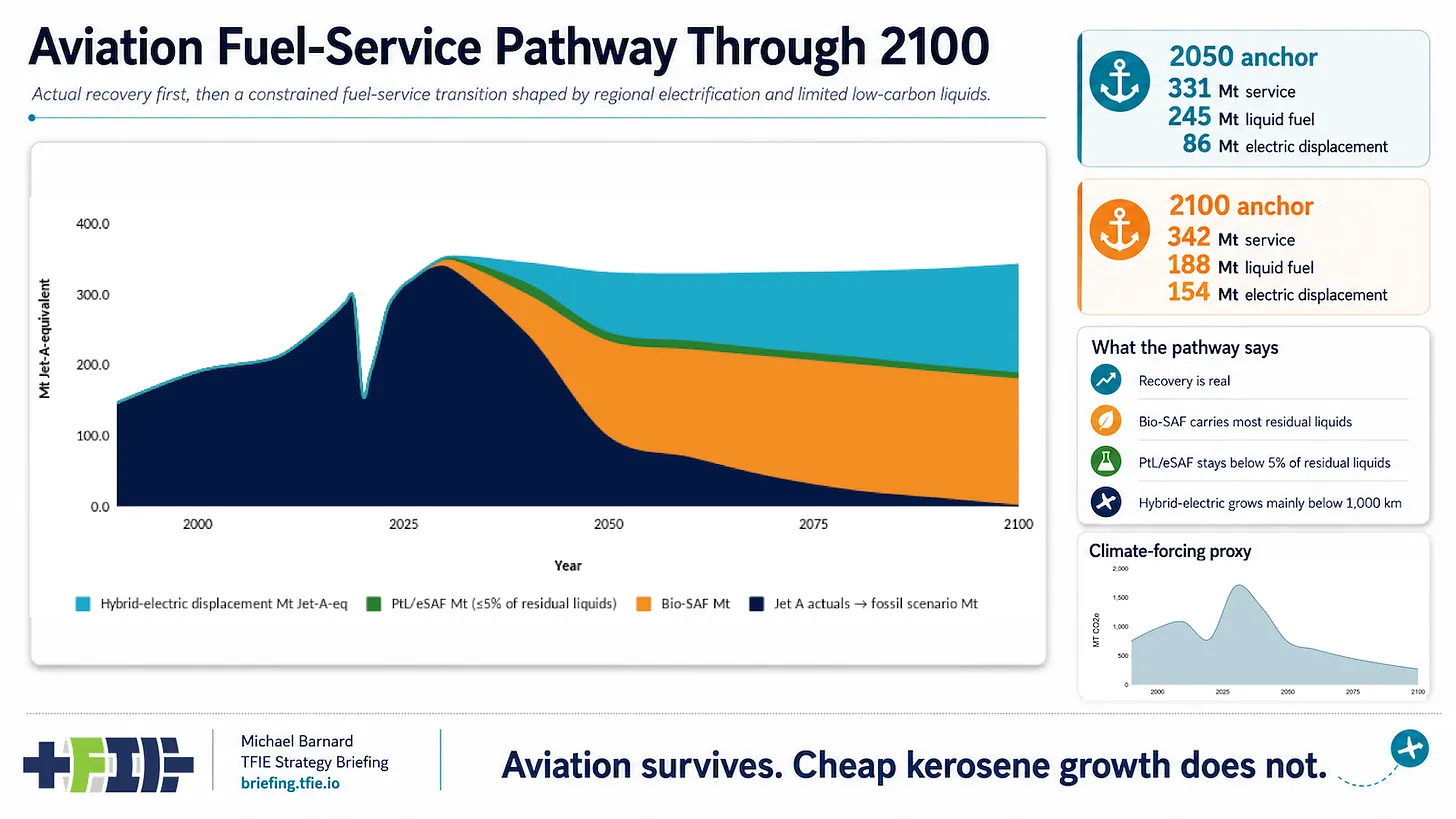
My aviation fuel-service projection through 2100 does not assume that flying collapses. It begins with the real post-COVID recovery and then splits the market. Under roughly 1,000 km, hybrid-electric aircraft have a credible pathway toward lower-cost regional mobility, especially where rail is weak, geography is awkward and existing airports can be reused. Longer flights remain dependent on high-density liquid fuels, and those fuels become increasingly expensive as mandates, feedstock constraints and carbon costs begin doing real work. The projection therefore treats aviation demand as something that responds to price and alternatives, rather than an economic entitlement that every decarbonization scenario must reproduce.
That creates an economic sorting process. A 5,000-km leisure journey does not become a 5,000-km electric flight. It might become a 700-km regional trip, a rail journey, a less frequent but longer holiday, another destination or no trip. A corporate traveller might combine three meetings, send one person rather than a delegation or replace an initial visit with video. Wealthy leisure demand remains resilient, but marginal discretionary demand becomes increasingly exposed as fares rise. The longer aviation pathway analysis explicitly models that split between regional electrification, persistent high-value flying and constrained long-distance liquid-fuel demand.
Fuel costs do not pass directly into fares because fuel is only part of airline operating costs. Even so, a large enough fuel-price increase can roughly double ticket prices, which is more than sufficient to alter price-sensitive demand, route frequency and destination choice. Meanwhile, regional electric and hybrid-electric aviation gains a cheaper energy basis and can capture some mobility that might otherwise have required a longer liquid-fuel flight.
The result is not an anti-aviation austerity scenario. Aviation survives. It becomes more regional where electricity can do the work, more selective where scarce liquids remain necessary and more expensive where the sector finally pays for its claimed decarbonization fuels. Some projected passenger-kilometres disappear, but their disappearance is not automatically a proportional loss of productivity or global GDP. Much of the spending and activity moves to another location, sector, mode or format.
I still boarded my flight this year. I am enjoying the UK and Ireland, and I expect the businesses receiving my money to consider my presence beneficial. That is an honest defence of personal travel. It is not proof that my passenger-kilometres are an engine of economic growth. The same distinction applies to an executive attending a routine conference simply because the travel budget exists.
Aviation is a valuable service. Its economic footprint is large. In this stress test, roughly 91% of passenger journeys sit in the chosen-consumption field, including both personal travel like mine and institutional travel whose purpose can often survive without the flight. The industry has strong economic cases to make for the remaining journeys where speed, distance or physical presence materially changes the outcome. Its much broader claim that continued passenger growth itself is an engine of prosperity fails when it refuses to tell those categories apart.
Subscribe to TFIE Strategy Briefing for evidence-led analysis of aviation, fuels and the wider energy transition.