

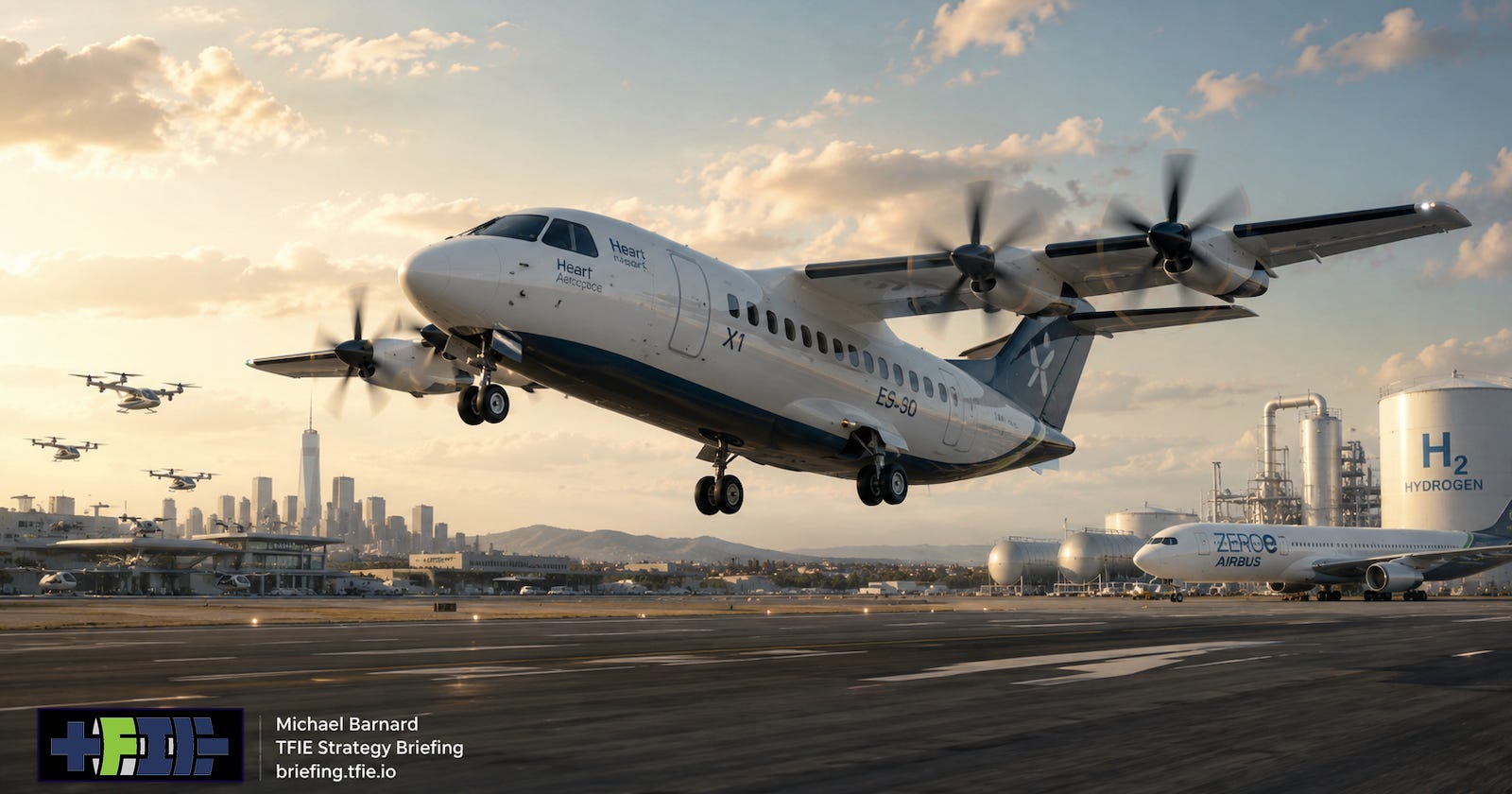
On August 12, Heart Aerospace’s X1 demonstrator lifted off from Plattsburgh International Airport in upstate New York, marking one of the most consequential electric-aviation flights to date. The 106-foot-span aircraft weighed more than 25,000 pounds at takeoff and flew for 27 minutes entirely on batteries, with its electric propulsion system delivering more than a megawatt at peak. Heart describes X1 as the largest battery-electric aircraft ever flown. The record matters less than what the flight represents: a full-scale aircraft approaching commercially relevant size took off, maneuvered and landed using batteries and electric motors alone. After years of redesigns, delays and hard engineering, Heart has moved regional electric aviation another step from projection toward physical reality.
In 2021, I interviewed Heart founder and CEO Anders Forslund, when the company was developing the 19-seat, fully electric ES-19 after closing a $35 million Series A. Forslund was already clear that this was nowhere near enough money to develop a commercial aircraft. His benchmarking and bottom-up estimate was around $500 million to reach early production and put the first airplanes into the air, with successive physical milestones required to unlock successive financing rounds. The number belongs to a different aircraft programme now, but the financing logic looks prescient. Aerospace eventually has to become hardware, and hardware has to perform before investors finance the next, considerably more expensive stage.
Heart has hardly followed a straight line. The ES-19 became the 30-seat ES-30, pure battery propulsion became hybrid-electric, the hybrid architecture changed again and a commercial-service target of 2026 became 2031. X1 is not the production propulsion configuration either: its four propellers were electrically driven from batteries, while the intended ES-30 combines electric propulsion with conventional turboprops. Heart is late and still has an enormous distance to travel through certification, manufacturing and airline operations. What has remained stable is the problem it is trying to solve. Regional airlines, airports, routes and passengers already exist, and short regional flights are an obvious place to exploit electricity’s efficiency and low energy cost if batteries can carry enough of the mission.
Aviation did not lack speculative transition capital while Heart was grinding through that process. It spent extraordinary amounts on two propositions whose central problems were visible well before most of the money arrived: urban eVTOL air taxis and hydrogen-powered passenger aircraft.
