

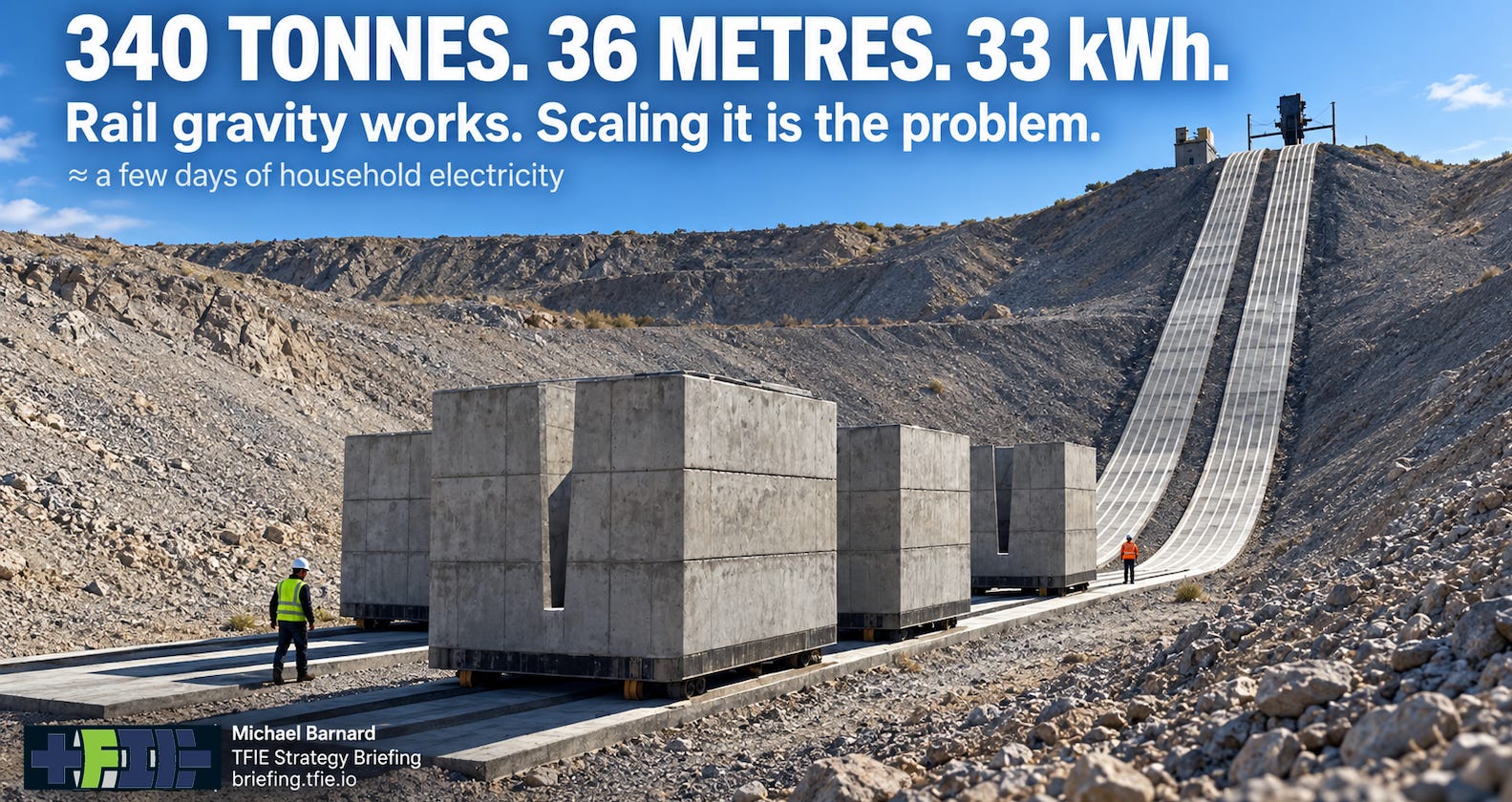
Two years ago, in my assessment of gravity storage, I considered both ordinary railways and funicular systems as ways of storing electricity by moving solid masses uphill. Ordinary steel-wheel railways need relatively shallow grades, which means long routes for comparatively little elevation. Funiculars solve the grade problem, but I argued that cable forces would constrain the masses enough to keep their energy capacity unimpressive. ARES North America has now demonstrated that I was too pessimistic about that second point. Its current GravityLine demonstrator at Gamebird Pit in Nevada replaces conventional railway adhesion and a traditional funicular cable with a stationary motor and chain drive. Sandia National Laboratories documents a pair of mass cars weighing roughly 340 tonnes climbing a slope of about 55% grade with approximately 36 metres of elevation change. Moving that much mass on that slope is legitimate heavy engineering progress.
The demonstration also makes the underlying problem with solid-mass gravity storage unusually easy to see. Multiplying 340 tonnes by gravity and 36 metres gives only about 33 kWh of gross potential energy, roughly four days of electricity consumption for a typical UK household. The same descending pair can produce several megawatts briefly because power is energy delivered quickly, but there simply is not much stored energy when even an enormous mass has moved through only a few dozen vertical metres. ARES has solved an interesting mechanical problem without changing the arithmetic that determines how much physical material a useful storage system requires.
Using Gamebird’s shallow elevation to dismiss the commercial concept would be unfair, so I gave ARES a much better site: 400 metres of effective elevation difference, more than eleven times Gamebird’s head. I kept the power rating modest at 20 MW but required twenty hours of output because ARES markets GravityLine for long-duration service extending beyond 24 hours. The resulting 400 MWh installation should be close to the market niche in which rail gravity has its strongest possible argument. It is small enough that a developer might claim pumped hydro is too cumbersome, while twenty hours is long enough that batteries have traditionally been assumed to become expensive.
That is where the comparison becomes damaging. Scaling ARES to that deliberately favourable case produces an industrial system involving hundreds of thousands of tonnes of moving mass, thousands of specialized carriers, substantial upper and lower storage areas, multiple heavy-load operating paths, a site-specific rolling-stock manufacturing programme and a permanent maintenance organization. It takes years to create and commission that physical inventory before the storage service is available. Conventional closed-loop pumped hydro performs the same gravitational-storage task with two modest reservoirs, a pressure pipe and a small powerhouse. Lithium-ion performs the same electrical service with standardized modules delivered from permanent factories. Both alternatives are simpler, faster to deploy as complete systems, and materially cheaper under the reference classes I tested.
ARES is therefore competing against technologies that already perform the same grid function rather than trying to prove that gravity can store electricity. Pumped hydro uses water as both the storage mass and much of its material-handling system, eliminating the thousands of individual machines needed to marshal solid mass. Batteries take the opposite route, putting the energy inventory into dense standardized modules manufactured at enormous scale. Rail gravity inherits the geographical requirements of gravity storage while adding a manufactured moving inventory and the industrial organization needed to build, sequence and maintain it.
The surprise came when I stopped treating ARES’s stored mass as cheap rock and started treating it as what the plant actually needs: thousands of enormous, purpose-built rolling machines that have to be manufactured, marshalled and maintained for decades. I gave the concept an unusually favourable 400-metre site and a modest 20 MW target, then compared the resulting plant with closed-loop pumped hydro and a 20-hour lithium-ion battery. One assumption in the ARES economics turns out to be doing an extraordinary amount of work, and once it is replaced with a reference-class estimate from real rolling-stock manufacturing, the apparent niche largely disappears. Below the paywall: the car count, the temporary factory, the logistics and maintenance burden, and the matched costs that show just how far apart the three storage options really are.