

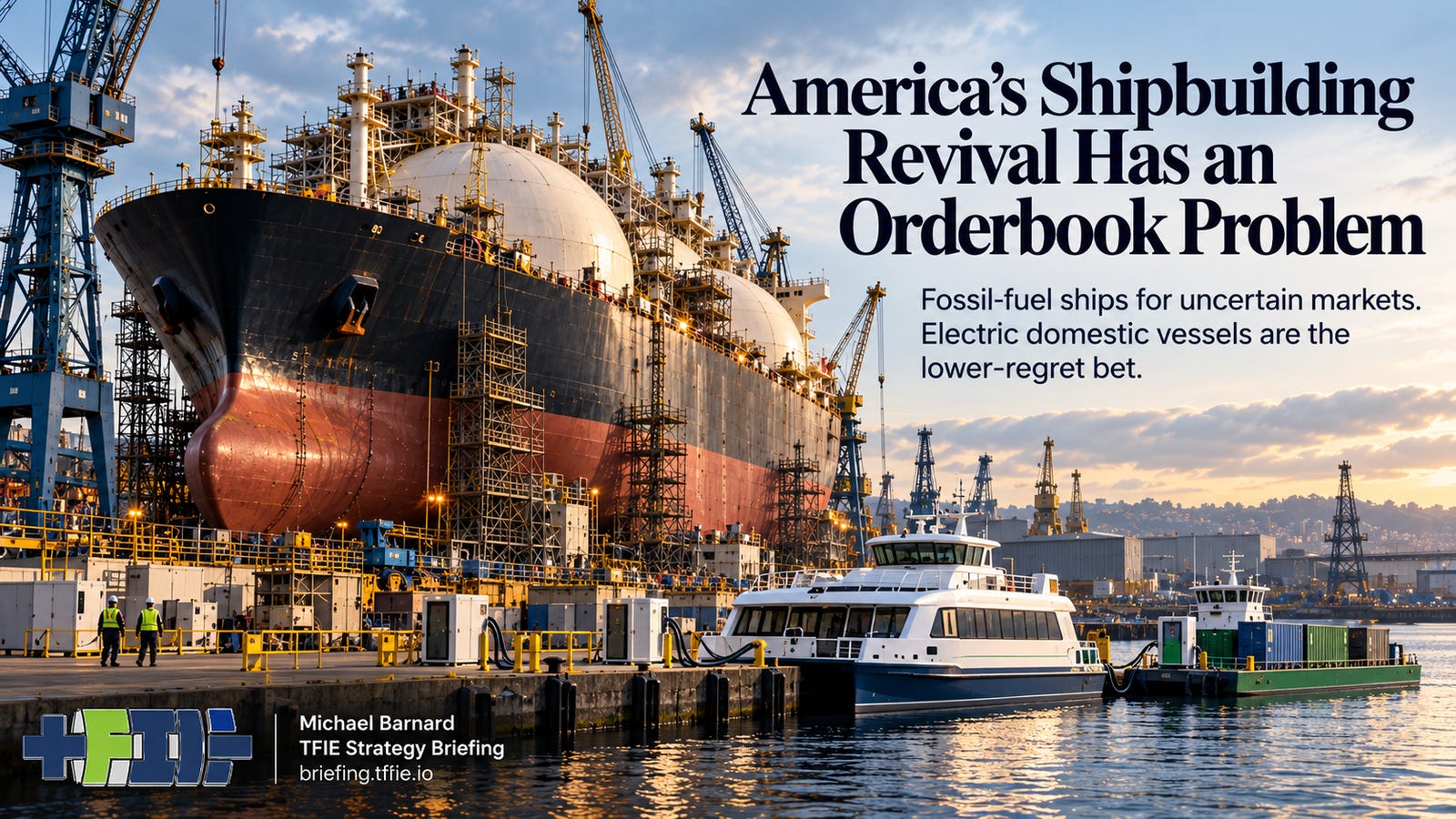
Hanwha’s Philadelphia shipyard has become the leading example of the Trump administration’s ambition to rebuild American commercial shipbuilding. Its orderbook includes two liquefied natural gas carriers, four firm orders for oil and chemical tankers, and options for another six tankers. Three LNG-fueled container ships for Matson were contracted in 2022, before Trump’s second administration. The newer petroleum and LNG carriers were ordered by other companies within Hanwha, not independent commercial customers. The investment in American industrial capability is real, but the emerging orderbook provides little evidence that shipping companies will voluntarily pay American construction prices.
In February, I argued in America’s New Maritime Plan Is Competing for the Wrong Century that Washington was approaching shipbuilding with industrial assumptions increasingly disconnected from maritime electrification. The orders and economics emerging since then make the problem more concrete. The United States is rebuilding the capacity to manufacture expensive ships for freight markets undergoing structural change, while leaving more durable opportunities largely to individual states and commercial operators.
Kinder Morgan’s January 2026 investor presentation estimates that a new American medium-range petroleum tanker costs more than $240 million and requires charter rates exceeding $115,000 daily to justify construction. Existing Jones Act tanker charters are around $90,000 daily. Kinder Morgan’s sixteen-vessel fleet is fully utilized, yet prevailing rates cannot support replacement construction at today’s prices. Comparable tankers can be built internationally for approximately $50 million. The protected American market is already struggling to support its own renewal.
Petroleum tankers face competition from existing American infrastructure as well. A 2025 report to the Commodity Futures Trading Commission estimated that gasoline could move from Houston to New York Harbor for less than 8¢ per gallon by pipeline, compared with approximately 20¢ by coastal tanker and 35¢ by rail. Tankers remain necessary for destinations without pipeline connections, but building them at several times international prices does nothing to improve their economics. Meanwhile, the International Energy Agency’s Global EV Outlook 2026 estimates that electric vehicles displaced 1.7 million barrels of oil daily in 2025 and could displace around 5 million by 2030. The US Energy Information Administration projects American petroleum and other liquids consumption declining 11–23% by 2050 in most of its scenarios.
LNG carriers have a different outlook. American exports may grow substantially, and ocean-going vessels are indispensable to international gas trade. But American-built LNG carriers must compete with the established Korean, Chinese and Japanese shipbuilding industries while renewables, storage and electrification increasingly challenge gas demand in importing countries. Hanwha’s first LNG carriers depend heavily on Korean construction, demonstrating where the manufacturing expertise and competitive costs currently reside. American cargo mandates can create protected orders, but they cannot guarantee customers or charter revenues through the 2050s.
The administration’s short-term thinking is apparent in the mismatch between these investments and the markets they must serve. Its commitment to expanding fossil fuels is informing decisions about industrial assets whose working lives will extend across numerous administrations. Rebuilding shipbuilding capacity is a legitimate objective with bipartisan support. Concentrating prominent early commercial orders in fossil-fuel transport is a questionable way to achieve it, particularly when the country has other maritime markets that do not depend on preserving today’s patterns of energy consumption.