

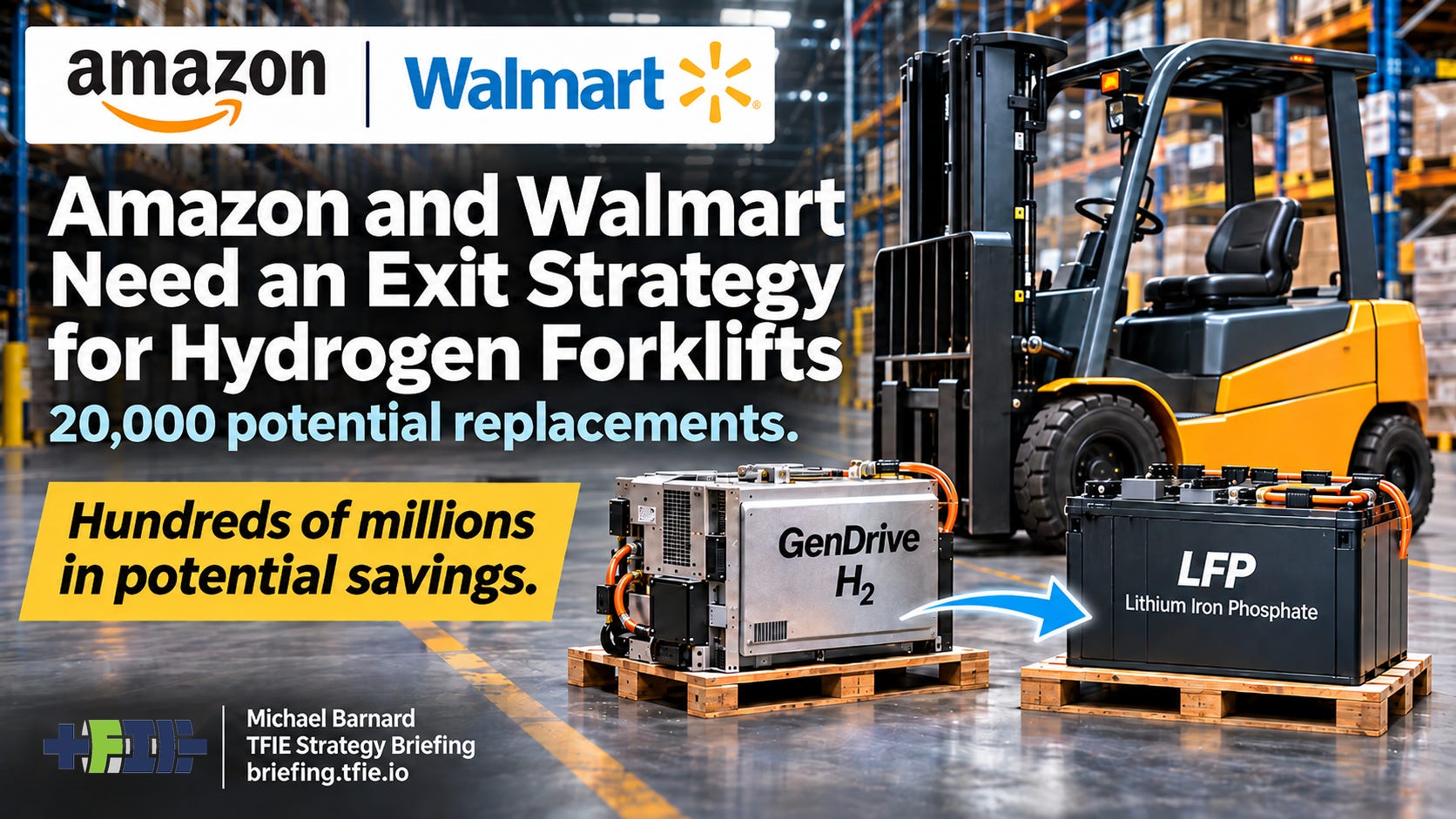
In its November 2026 earnings call, Plug Power identified approximately 20,000 forklift fuel cell systems it expects Amazon and Walmart to replace over the next two to three years. At an indicative $19,000 per GenDrive, that’s a potential $380 million equipment sales opportunity for Plug. For Amazon and Walmart, it represents a capital allocation decision that deserves more scrutiny than a routine equipment refresh.
Richard Rumelt’s Good Strategy/Bad Strategy provides a framework for that decision. His kernel of good strategy consists of a diagnosis of the challenge, a guiding policy for addressing it and a set of coherent actions that implement the policy. For companies with warehouses full of hydrogen forklifts, the diagnosis starts with recognizing how much has changed since they first invested in hydrogen, including that their hydrogen supplier is making it easier for them to leave.
Hydrogen fuel cells addressed limitations of lead-acid batteries in warehouses. Lead-acid batteries required lengthy charging periods, dedicated battery rooms and, in intensive multi-shift operations, battery swapping. Hydrogen refueling took minutes. Modern lithium iron phosphate (LFP) batteries have largely eliminated the need for battery swapping and dedicated battery rooms. Opportunity charging during employee breaks and shift changes, higher usable battery capacity and consistent power delivery throughout a shift have made lithium-ion forklifts a mature alternative for intensive warehouse operations.
According to the International Energy Agency’s Global EV Outlook 2026, LFP accounted for over 55% of electric vehicle battery capacity deployed globally in 2025, and LFP battery packs were over 40% cheaper per kWh on average than nickel manganese cobalt alternatives. Chinese manufacturers alone sold 562,200 lithium-ion forklifts in 2025, including 249,000 exports, according to Hangcha’s annual report. Lithium-ion accounted for 46.5% of their electric forklift sales and 77.2% of their electric counterbalanced forklift sales. Plug’s customers have the option of exchanging a niche technology dependent on a financially distressed supplier for one supported by a competitive global manufacturing ecosystem.
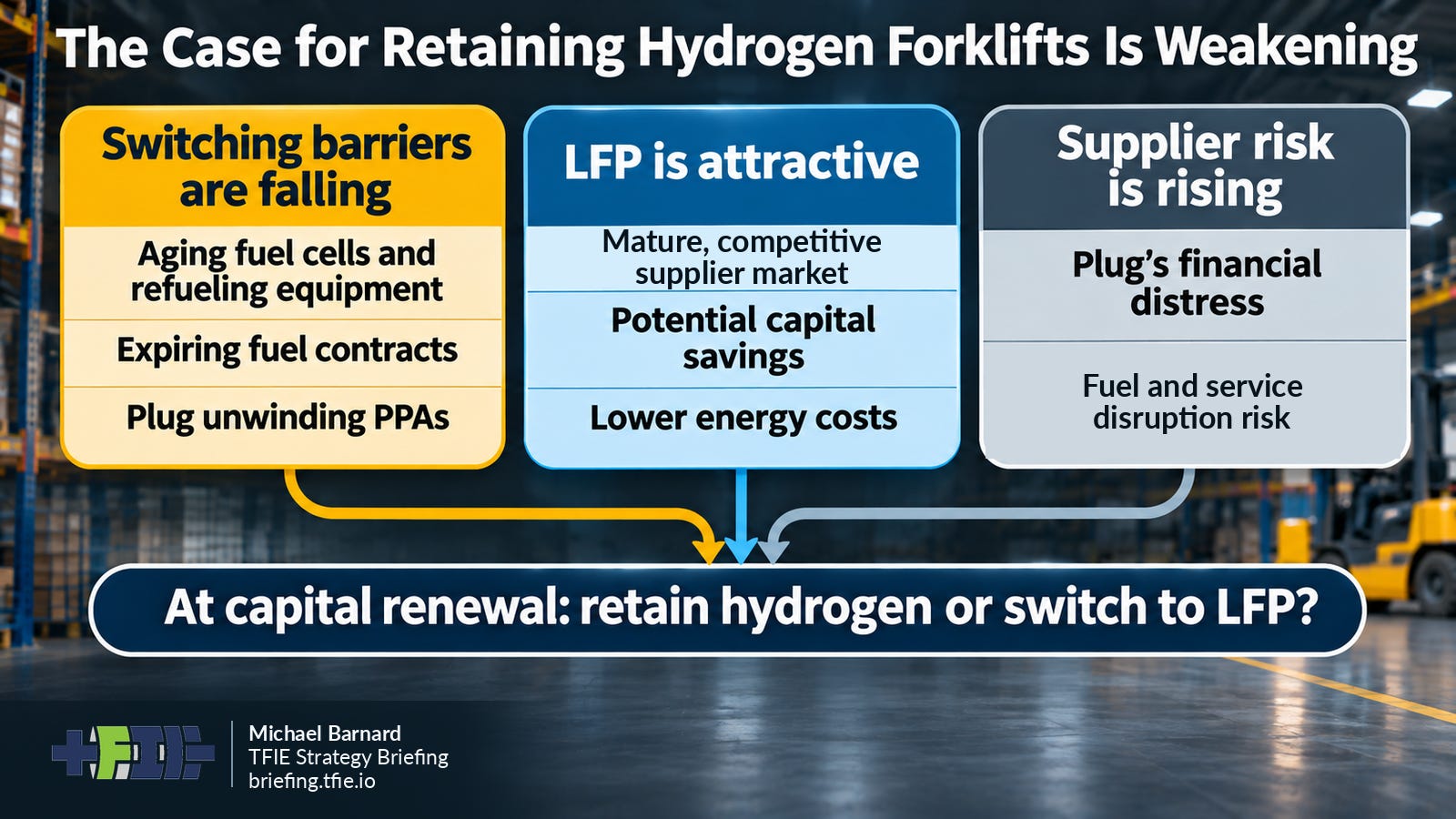
Amazon and Walmart have had reasons to retain hydrogen at existing facilities. Dedicated refueling infrastructure represented substantial investments, while long-term commercial arrangements with Plug reduced the need to make recurring equipment procurement decisions. Plug’s power purchase agreements provided forklift power as a subscription service, with the company retaining equipment, financing and maintenance obligations. Switching to batteries meant unwinding commercial arrangements as well as changing equipment and energy infrastructure.
Plug is now unwinding some of those arrangements itself. During its November earnings call, the company disclosed that it was moving customers from legacy power purchase agreements to equipment purchases and separate service contracts. In some cases, it is buying out financing arrangements early to recover restricted cash. Its third-quarter regulatory filing disclosed that $342 million remained tied up in corporate-wide lease-related cash collateral, down from $512 million at the beginning of the year.
As I wrote in CleanTechnica in November 2025, Plug was already cutting maintenance expenditures, reducing its workforce and monetizing assets to sustain operations. A year later, despite substantial cost reductions, it recorded another $75 million quarterly operating loss. Its loss-making subscription arrangements represent a customer retention mechanism, funded by capital raised on the markets during hydrogen hype cycles, it can no longer afford to sustain in their original form. New service and fuel agreements may retain some contractual switching barriers, but transferring equipment ownership exposes future GenDrive replacements to competitive capital procurement.
Amazon’s first GenDrive installation dates from October 2016, meaning some of its facilities will have been operating hydrogen equipment for 13 years when its current hydrogen purchasing agreement expires in August 2029. Individual refueling components may have been replaced in the interim, but compressors, dispensers and control systems have finite operating lives and require periodic overhauls. Equipment replacement, infrastructure refurbishment and contract expiration create natural opportunities for technology substitution. Retaining hydrogen increasingly means committing new capital rather than benefiting from investments already made.
GenDrives are designed to occupy the battery compartments of conventional electric forklifts. In many cases, conversion would involve installing a suitable industrial battery and charging infrastructure rather than replacing the forklift. Plug’s published specifications provide a basis for estimating equivalent battery sizes. A nominal 48-volt, 600-ampere-hour LFP battery provides approximately 31 kWh of storage and 28 kWh at 90% depth of discharge, comparable to the usable electrical energy provided by a typical larger GenDrive hydrogen tank. Reach trucks and pallet trucks generally require smaller batteries. Opportunity charging can further reduce the capacity required to support a full shift.
Advertised prices for industrial LFP forklift batteries range from approximately $5,500 to $11,000 for 48-volt, 600-ampere-hour systems. Vatrer’s 600 Ah system includes a charger at the lower end of that range, while BlitzNXT’s 608 Ah industrial battery starts at $10,799. Using conservative battery prices, dedicated chargers, allocated electrical infrastructure costs and installation allowances, indicative installed conversion costs are $15,500 for counterbalanced forklifts, $11,750 for reach trucks and $7,500 for pallet trucks.
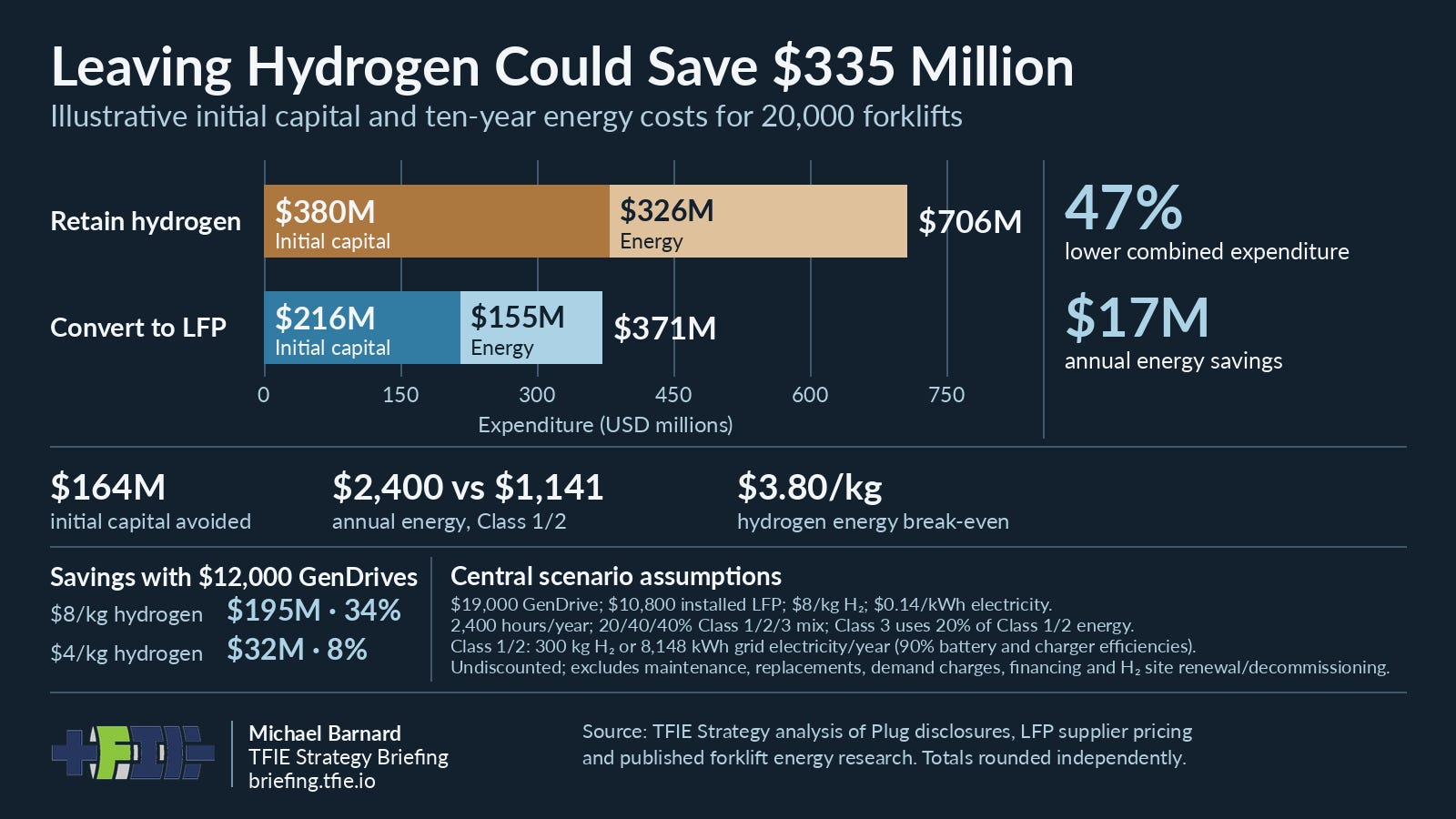
An illustrative fleet consisting of 20% counterbalanced forklifts, 40% reach trucks and 40% pallet trucks would have an average installed conversion cost of $10,800. Applied to 20,000 units, that represents $216 million in capital expenditure compared with $380 million for replacement GenDrives, a difference of $164 million, or 43%. The GenDrive price is a proxy derived from Plug’s fuel cell equipment revenues, which include other products, and the fleet composition is an assumption rather than Amazon or Walmart procurement data.
Electricity costs substantially less than hydrogen for the same warehouse operations at representative energy prices. A 2022 peer-reviewed forklift lifecycle cost assessment drawing on National Renewable Energy Laboratory operational data used annual hydrogen consumption of 300 kg and electricity consumption of 6,600 kWh for larger forklifts operating 2,400 hours annually. Accounting for the study’s battery and charger efficiency assumptions increases annual grid electricity requirements to approximately 8,150 kWh. At $8/kg for hydrogen and $0.14/kWh for electricity, annual energy costs are $2,400 for hydrogen and $1,141 for batteries, a 52% reduction.
Hydrogen would have to cost approximately $3.80/kg to match electricity costs under those assumptions. Plug’s third-quarter results indicate that its hydrogen supply costs were $1.52 for every dollar of reported net hydrogen revenue, which includes customer warrant-related accounting deductions. Its customers should not assume that today’s contracted prices will persist. The 2022 study reached a similar conclusion using a more comprehensive lifecycle cost model, estimating ten-year costs of approximately $15,000 for LFP and $37,000 for fuel cells at $8/kg hydrogen.
Applying the energy costs to the illustrative fleet of 20,000 forklifts, with pallet trucks modeled at 20% of the energy consumption of larger forklifts, yields annual energy savings of approximately $17 million. Combined with the initial capital savings, the undiscounted ten-year difference approaches $335 million, a 47% reduction in combined expenditure. Amazon and Walmart’s actual contracted hydrogen prices are not public, and their purchasing power may secure GenDrive prices considerably below the $19,000 proxy. Reducing the GenDrive price to $12,000 still yields combined savings of approximately $195 million at $8/kg hydrogen, or $32 million at $4/kg hydrogen.
The comparison includes initial capital expenditure and ten years of energy consumption for each unit, rather than forecasting the companies’ actual cash flows over the next decade. Electrical demand charges, site-specific infrastructure upgrades, hydrogen infrastructure decommissioning, financing, maintenance and subsequent battery and fuel cell replacements require further assessment. The comparison also excludes the potentially substantial avoided costs of refurbishing hydrogen refueling infrastructure. Even with much cheaper fuel cells and hydrogen than the central scenario assumes, the economics warrant competitive LFP assessments before either company commits to another generation of GenDrives.
Which warehouses should convert first? How should operators coordinate equipment replacement, contract expiration and infrastructure renewal? How can they protect operations if Plug’s financial circumstances deteriorate further? Subscribe for a strategy to manage the transition.