

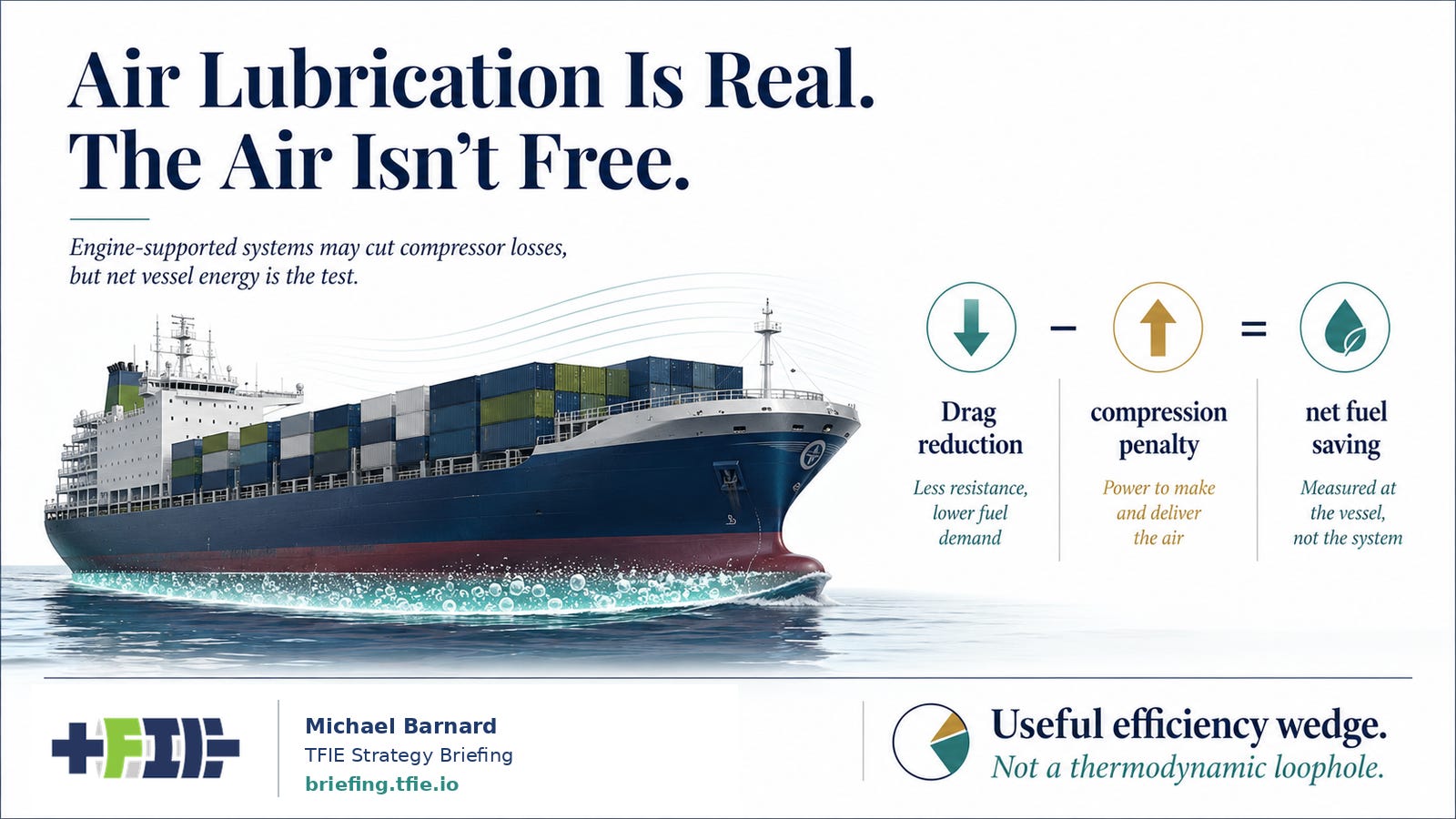
A maritime contact sent me an interesting item this week about Everllence and Silverstream’s Engine Supported Air Lubrication concept. It is exactly the kind of thing worth slowing down for, because it sits at the intersection of real engineering, transition optimism, and the faint suggestion that someone may have found free compressed air in the engine room. Sadly, no. The concept is clever, but the first law of thermodynamics remains stubbornly unimpressed.
The idea is straightforward. Conventional hull air lubrication systems use compressors to push air beneath the hull, creating a bubble layer or air layer that reduces friction between the hull and seawater. Everllence’s contribution is to use pressurized scavenge air from the main engine instead. In plain English, that is compressed intake air in the engine’s breathing system before combustion, not exhaust and not waste air. The concept integrates the air supply into the engine architecture and reduces or avoids separate auxiliary air-lubrication compressors in some operating conditions.
That is a useful engineering improvement to assess, but the air still has to be compressed, the work still has to be paid for, and the ship still has to show a net energy saving after the air system’s own requirements are counted. The system may reduce one chain of losses by using a larger and already-integrated air machine, but it does not turn compressed air into a free byproduct.
The reported number is a useful clue. Everllence’s engine-integrated approach is described as delivering estimated net fuel savings of about 3.5%. That is not the sort of number a hype machine usually leads with. It is modest, plausible, and exactly the kind of improvement that matters in a sector where fuel bills are large, carbon costs are rising, and future low-carbon fuels are expensive or constrained.
The net saving is the point
The technology is not new, and it is not nonsense. The basic idea is to reduce skin-friction resistance by separating part of the hull surface from water with air. The American Bureau of Shipping’s air lubrication advisory describes the main families as bubble drag reduction, air layer drag reduction, and partial cavity drag reduction. Those distinctions matter to naval architects, but the transition question is simpler: does the system reduce total vessel energy demand after counting the power required to generate and distribute the air?
Creating air under the hull requires compression, piping, outlets, controls and a hull shape that lets the air stay where it matters. If the bubbles escape to the sides, detach too quickly, cover the wrong area, or require too much compression energy, the gross friction reduction becomes a small operating benefit or no benefit at all. That is not a critique of the approach. It is the ordinary discipline required for any efficiency technology that spends energy in one part of the system to save more somewhere else.
This is why the Everllence and Silverstream development is interesting. It does not make compression disappear, but it may improve the compression pathway. Instead of running separate electrically driven compressors, the system uses air already being compressed in the main engine’s scavenge-air system. In principle, that could avoid the generator, electrical bus, drive, motor and dedicated compressor chain, replacing it with a controlled tap from large, optimized main-engine air machinery.
The question is narrow and practical: is the marginal penalty of taking scavenge air from the main engine lower than the all-in penalty of compressing air electrically? That is not a slogan. It is a vessel-specific energy calculation.
Orders are real, but the denominator is stubborn
This deserves more respect than it sometimes gets. Silverstream says it passed 200 orders in 2024, including 57 LNG carriers, with 82 systems already operating at the time. That is no longer a laboratory curiosity or a naval architecture conference slide.
The European Maritime Safety Agency’s 2026 study treats hull air lubrication as an interesting but still maturing technology, and says the industry still needs a clearer picture of how systems perform under service conditions. That is the right tone. It is past the science-project stage, but not yet boring infrastructure. Shipping is full of clever devices that work in trials and then become maintenance footnotes, and the professional question is which ones survive normal operations.
The adoption pattern is revealing. EMSA says installation is currently dominated by LNG carriers and container ships, with cruise ships emerging as the third-largest segment. Clarksons data reported through Riviera put air-lubrication systems on 369 vessels in the live fleet as of January 2026. UNCTAD’s broader merchant-fleet denominator is roughly 112,500 vessels of at least 100 gross tons, including about 60,300 over 1,000 gross tons. That makes the fitted fleet meaningful, but still tiny: about 0.6% of the larger-vessel fleet.
That denominator changes the tone of the assessment. Hull air lubrication has crossed out of “interesting idea” territory. It has not crossed into fleet transformation. The public conclusion is simple enough: this is a credible efficiency measure for some ships, not a maritime decarbonization pathway for the fleet.
The harder professional question is how much of the fleet survives the filters: hull geometry, route profile, remaining vessel life, compressor penalty, electrification potential, cargo durability, and measured net savings. Orderbook headlines are a starting signal. They are not the answer.
Air lubrication belongs in the efficiency bucket, not the decarbonization bucket. The paid analysis below works through the filters that matter in procurement and strategy: vessel class, hull form, compressor penalty, route profile, cargo constraints, remaining vessel life, competing efficiency options such as wind-assist, and the update triggers that would show whether the technology is becoming a serious fleet tool or staying a useful niche retrofit.
