

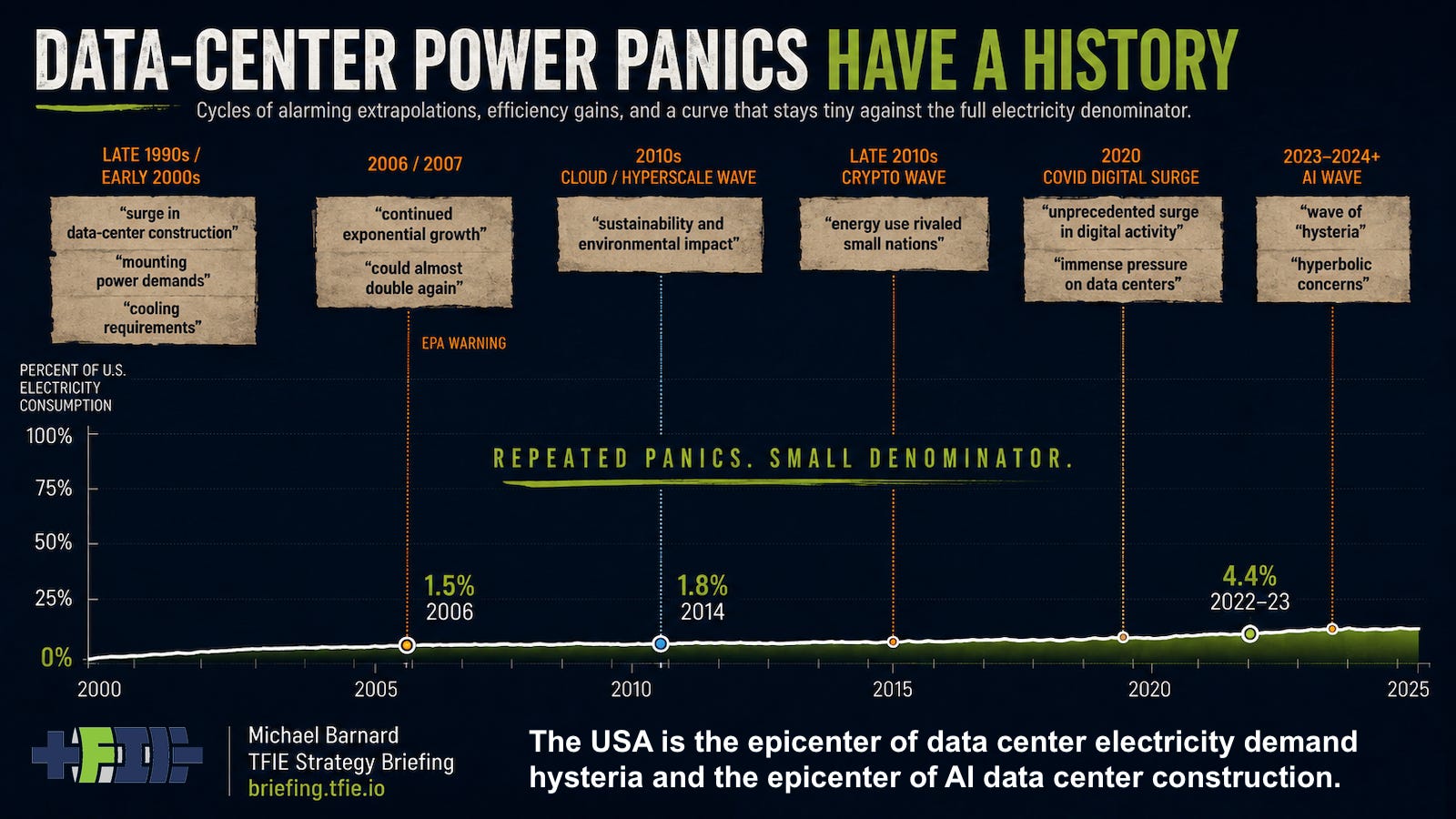
This is not the first time data centres have appeared poised to eat the electricity system. I’ve watched versions of the same story through the server-farm boom, cloud computing, hyperscale facilities and now generative AI: take the fastest-growing digital workload, multiply it by the electricity intensity of today’s hardware and software, and produce a curve that looks alarming a few years out. The underlying concern is usually legitimate. What repeatedly goes wrong is the assumption that the computing industry will continue doing the same work with the same efficiency while electricity, chips, cooling and capital are becoming expensive constraints.
In 2007, the US Environmental Protection Agency reported that servers and data centres had consumed about 60 billion kWh in 2006, roughly 1.5% of US electricity consumption. Consumption had doubled over the previous five years and the EPA expected it could almost double again over the next five. That was a perfectly reasonable extrapolation from what had just happened. Instead, virtualization, more efficient servers, better cooling, improved facility design and much higher utilization changed the slope.
Berkeley Lab’s 2016 retrospective showed just how much. US data-centre electricity consumption had risen almost 90% from 2000 to 2005 and another 24% from 2005 to 2010, but only about 4% from 2010 to 2014. By 2014, data centres consumed about 70 TWh, just 1.8% of US electricity. Digital activity had not stopped expanding. The amount of useful computing extracted from the electricity had changed dramatically.
I come to this view from long experience in global technology rather than as a specialist in data-centre energy forecasting. Over several decades in technology consulting, software and infrastructure around the world, I have helped architect, rearchitect and deploy workloads into enterprise data centres and, later, public and private clouds, including systems involving large-scale data, analytics, AI and other computationally demanding applications.
I have also spent enough time fixing troubled technology projects to have internalized one of software engineering’s less glamorous rules: optimize late. Performance is usually optimized when it becomes an actual constraint, because hardware, architecture, software and operating practices all have costs and engineers attack whichever bottleneck matters most. When compute, memory, cooling, network capacity or electricity becomes expensive enough to matter, enormous engineering effort shifts toward efficiency. That experience does not make me a data-centre electrical engineer or an AI-compute researcher, but it does give me a professionally grounded reason to be skeptical of forecasts that take today’s energy intensity, multiply it by tomorrow’s workloads and assume the technology stack between those two points will stand still.
That history is why I remain skeptical of treating today’s 2030 projections as destiny. The current AI wave has clearly broken the old flat US curve upward, and the increase is material. Berkeley Lab now estimates that data centres could represent 9.5% to 15.3% of US electricity use in 2030, with an 11.8% central estimate. Its modelling is substantially better than simply adding up developer announcements: it uses expected equipment shipments, per-device consumption, cooling performance, facility types and locations. But a sophisticated forecast is still a forecast.
Between a proposed AI campus and an operating electrical load sit financing, chip availability, transformers, substations, transmission, interconnection approvals, construction, customers and utilization. More fundamentally, the AI products themselves have to justify continued expenditure. Five years is a long time in computing. Hardware generations turn over repeatedly, model architectures change, software improves, and workloads that seem intrinsically expensive today can become mundane surprisingly quickly. Treating a 2030 data-centre electricity estimate as though the plants were already commissioned repeats the same category error I keep seeing in energy project pipelines.
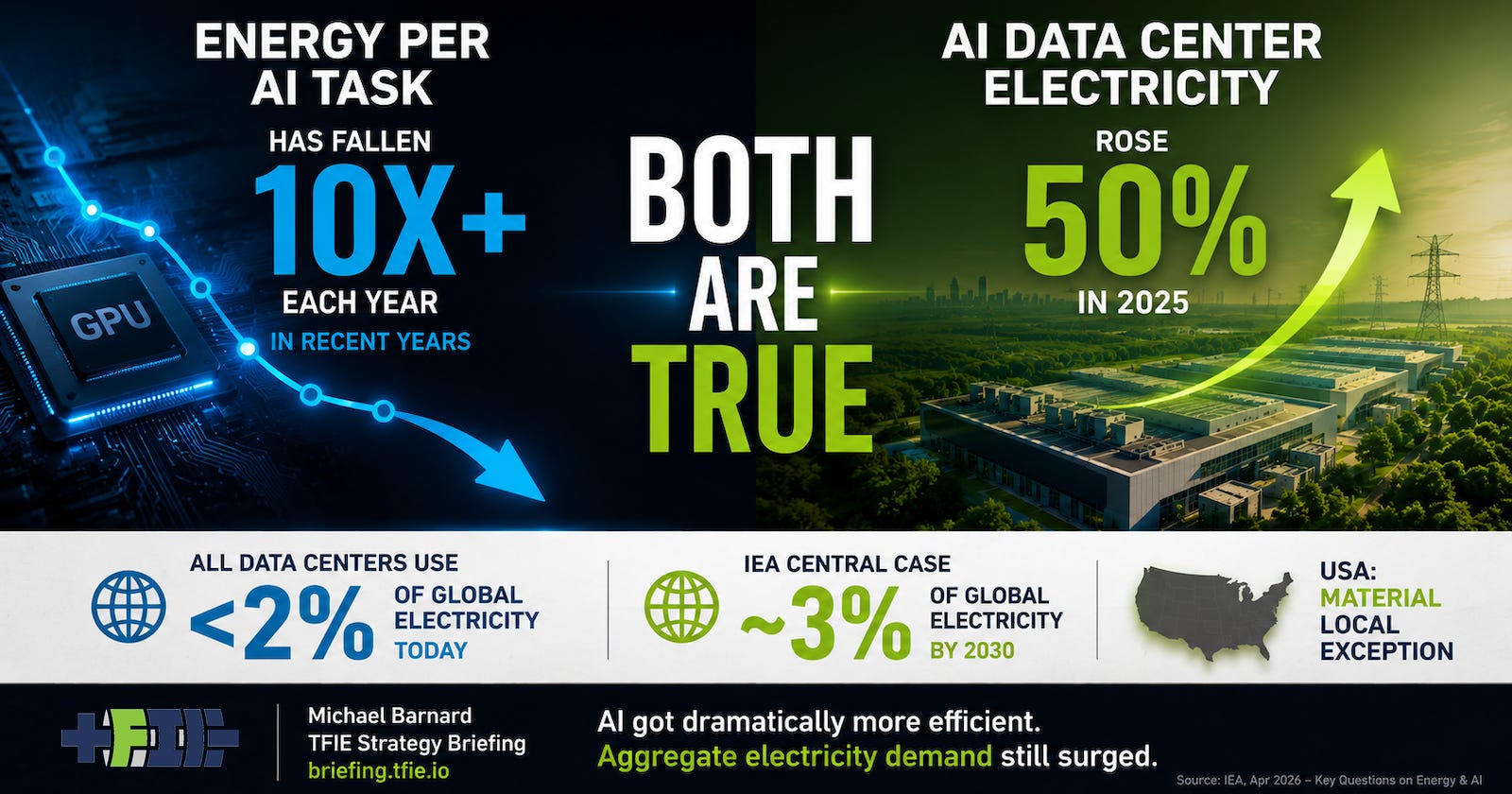
The efficiency evidence since my January 2025 article reinforces rather than undermines that skepticism. Energy consumption per AI task has been falling at extraordinary rates as chips, model architectures and software improve. DeepSeek was one early reminder that enormous computational savings were available outside brute-force hardware scaling, and successive accelerator generations keep increasing useful computation per unit of electricity. Jevons effects are real—cheaper inference encourages more inference—and aggregate electricity consumption has continued rising. But rebound does not make efficiency disappear. It means the eventual load depends on two rapidly changing variables rather than one.
Globally, keeping the denominator in view makes the AI electricity panic look much less impressive. The IEA estimated all data centres, not just AI facilities, at about 1.5% of world electricity consumption in 2024. Its central case reaches just under 3% in 2030. That is rapid sectoral growth, but it is not AI swallowing the global power system. China, industrialization, cooling, ordinary buildings, electric transport and other loads continue to drive far larger volumes of electricity growth.
The United States is different because it hosts a disproportionate share of the world’s computing infrastructure. The IEA estimates that it accounted for about 45% of global data-centre electricity consumption in 2024, and capacity is heavily concentrated in a handful of regional clusters. A globally modest load can therefore become a very large local problem in Virginia, Texas or another hyperscale corridor. Utilities cannot tell a gigawatt-scale campus that it is only a fraction of a percent globally when the local transformer, transmission line or generating fleet does not exist.
That is the part of the current concern I take most seriously. Data centres are large, concentrated, high-load-factor consumers that can appear faster than conventional grid infrastructure. They should pay for the generation, wires and substations they require, and utilities and regulators should distinguish firm projects from speculative interconnection requests. None of that requires accepting every 2030 demand projection at face value.
The long history argues for a more disciplined position. The 2000s server boom really did increase electricity consumption. The forecasts still overshot because efficiency transformed the industry. Cloud computing really did explode. Consolidating workloads into hyperscale facilities often reduced rather than multiplied the electricity required per unit of digital service. AI is now producing another genuine upward step, and rebound effects are stronger than I expected when I wrote in early 2025. But the same forces that spoiled previous straight-line extrapolations—engineering, economics and physical constraints—are already working on this one.
So I would update the earlier article without repudiating its central point. AI-related electricity consumption is rising, particularly in the United States, and the US grid needs to deal with it. The old implication that absolute demand would start flattening almost immediately was too optimistic. But the more sensational claim—that AI is on its way to becoming an overwhelming global electricity burden—still does not survive either the denominator or the history. The curve has turned upward. That does not make the forecast end point inevitable.
For more denominator-first analysis of electricity demand, grid constraints and technology hype, subscribe to TFIE Strategy Briefing.
I believe we might see a bit of an overshoot just now, mainly because hyperscalers seized the opportunity of the big hype faster and with more political support. In the long run my question was from the start, where will the majority of AI use land? The answer was to me from the very beginning: in devices at the edge. And therefore inference has to move from a data centre onto a local and in most cases mobile device. This is for safety, security and convenience the right place. To enable this companies like Apple, Samsung, Xiaomi, and the likes will be looking to reach efficiencies that do not diminish battery life, and it seems like Apple is already well under way with the architecture of their Mac Pros and the shared memory setup.
As you rightly say, the use of AI will increase and also the number of data centres will increase and thereby the electricity consumed by them. But only the AI training labs will be the places of the gigantic power consumption and therefore pose real issues and threats to local grids.