

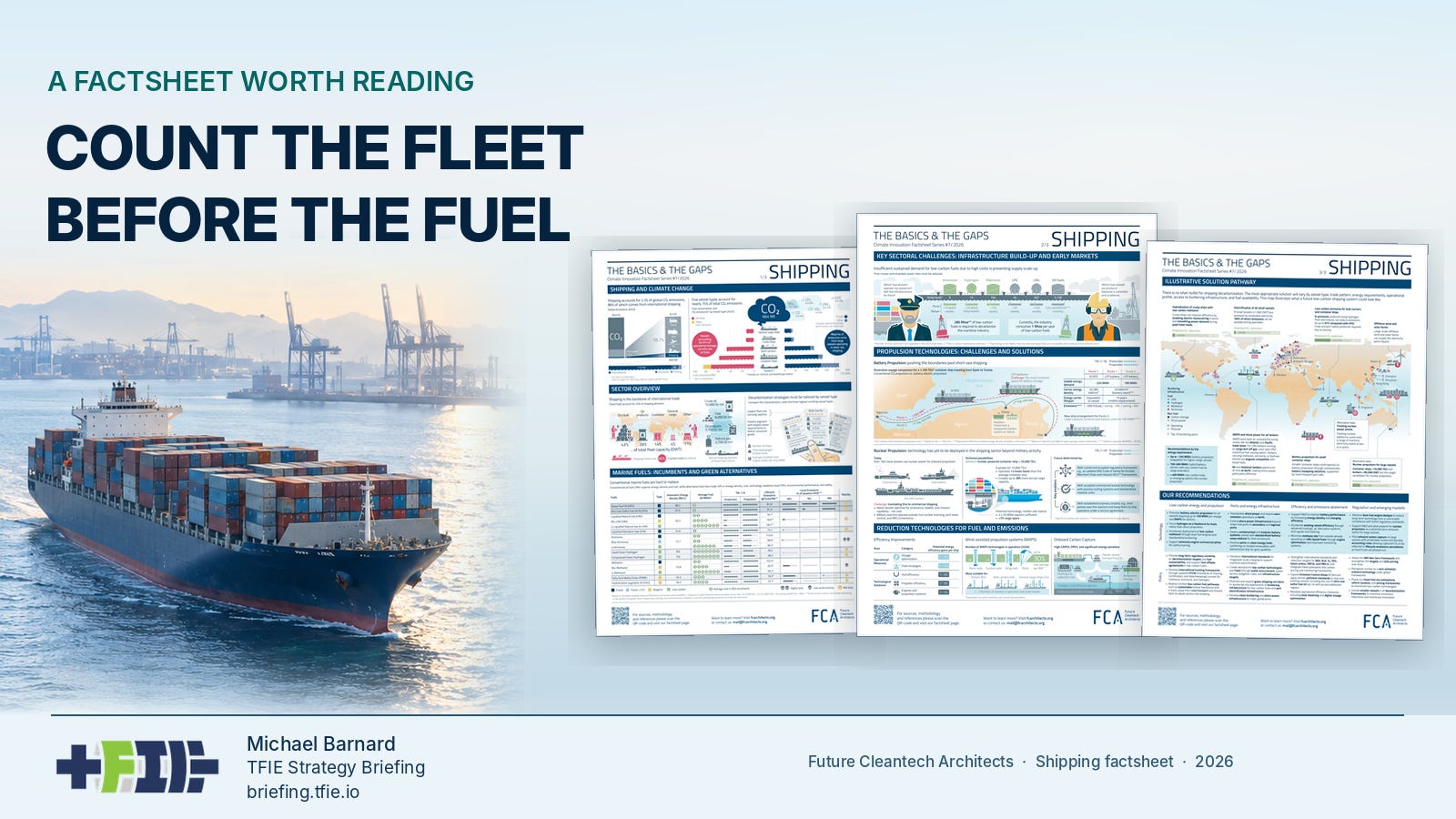
Shipping decarbonization is difficult enough to explain in a comprehensive technical report. Reducing it to three visually accessible pages for policymakers is a considerably greater challenge. The maritime industry encompasses everything from harbour tugs and inland barges to ferries, coastal cargo vessels, massive container ships and bulk carriers crossing oceans. Their operating requirements vary enormously, while the competing decarbonization proposals span energy efficiency, shore power, batteries, wind assistance, biofuels, synthetic fuels, hydrogen, ammonia, onboard carbon capture and nuclear propulsion. Each comes with different economic assumptions, operational constraints, safety considerations and levels of commercial maturity.
That makes Future Cleantech Architects’ recently published shipping factsheet a welcome contribution. The German nonprofit think tank’s The Basics & The Gaps series is intended to make complex climate technologies comprehensible to policymakers without requiring them to become engineers or energy systems analysts. Its October 2026 shipping edition succeeds in communicating a great deal of useful information without losing the reader in a forest of technical qualifications. It is a genuinely useful reference, particularly for people who need to understand the relative significance of technologies without spending weeks researching maritime engineering.
I had an opportunity to contribute to the development of the factsheet when Future Cleantech Architects invited me to conduct a paid, independent peer review of a July draft. My initial assessment was positive. The original was visually sophisticated, analytically ambitious and better researched than many shipping-decarbonization presentations I encounter. The concerns I raised had less to do with incorrect data than with how readers might interpret individually defensible numbers and comparisons. In particular, I was concerned about giving technologies with radically different maturity, cost and system relevance similar prominence, and about emissions and cost comparisons with different underlying boundaries.
There was also a more fundamental question about whether the industry’s current fossil fuel consumption represented the amount of alternative fuel it would eventually require. The October publication contains substantial revisions addressing several of these issues. Individual editorial decisions belong to FCA’s team, but the finished product demonstrates the benefits of revisiting the assumptions and presentation of an already credible piece of work.
The marine fuels table is a particularly useful improvement. The published version distinguishes conventional fossil fuels from fossil-derived fuels with carbon capture, biogenic fuels and low-carbon alternatives. LNG and LPG are clearly identified as fossil fuels, avoiding the misleading impression that lower combustion-stage CO₂ emissions necessarily make them low-carbon shipping solutions. A lifecycle greenhouse gas intensity column replaces a more complicated presentation of emissions metrics, while indicators for local pollution, cost, technology readiness and toxicity help readers understand why fuel substitution is not straightforward.
That matters because methane leakage and engine methane slip can materially change LNG’s climate performance, just as the electricity, hydrogen, carbon sources and production pathways used for synthetic fuels determine their actual emissions. The improved table makes more of these differences apparent without demanding that readers reconstruct the underlying calculations themselves. It also demonstrates how presenting lifecycle emissions consistently can help policymakers distinguish genuine greenhouse gas reductions from improvements in combustion emissions alone.
The treatment of electrification is similarly welcome. FCA’s worked example of a 1,100 TEU container ship operating between Spain and North Africa demonstrates that batteries deserve consideration well beyond short ferry crossings. The analysis explores voyage requirements, battery arrangements and swapping opportunities, recognizing that route structure and port infrastructure can be as important as a vessel’s theoretical maximum range. The policy recommendations extend that discussion to charging standards, modular batteries, shore power, regional ports and hybrid-electric architectures. These are valuable additions because shipping electrification is increasingly an infrastructure and operations question as much as a battery technology question.
Emerging options also receive more appropriate qualifications. Ammonia’s toxicity is more prominent, nuclear propulsion is presented with explicit moonshot language, and onboard carbon capture comes with clearer acknowledgment of its energy and economic penalties. The accompanying methodology is considerably more transparent about assumptions and sources. These improvements make the factsheet a better policy reference because they help distinguish what technology can theoretically do, what businesses are beginning to deploy, and what can deliver meaningful decarbonization at scale.
The published FCA website also introduces a particularly important analytical perspective: count the fleet before comparing its replacement fuels. That principle has implications extending well beyond the choice between methanol, ammonia, biofuels and hydrogen. It changes the size of the problem those fuels are being asked to solve, and it is where the factsheet could become even more useful in a future edition. The underlying questions concern the future of maritime trade, the vessel classes that will dominate it, the efficiency improvements available and how much of the remaining work electricity can perform.
The rest of this assessment examines those questions, including what FCA’s 280-million-tonne fuel-replacement estimate does and does not tell policymakers, and how technology readiness and competing fuel markets affect investment decisions. This deeper analysis is free to read with a TFIE Strategy Briefing subscription.